
What Is Private Credit? A Plain-English Guide to How It Works (2026)
By Credi Team

TL;DR
- Private credit is lending done outside banks and public bond markets. Investment funds and other non-bank lenders negotiate loans directly with companies and usually hold them until they are repaid.
- It grew because banks pulled back from riskier and smaller borrowers after the 2008 crisis, while companies wanted faster, tailored loans. Private credit funds now manage over $2.5 trillion globally (BIS, March 2025).
- Lenders get paid from the borrower's interest, usually a floating rate, and from repayment at maturity. Investors receive what is left after fees and any losses.
- The main types are direct lending to companies and asset-based finance, which lends against things like receivables or equipment. They behave very differently, especially in how long your money is tied up.
- The big risks are illiquidity, defaults and opaque valuations. Private credit is not guaranteed, and investors should know exactly how and when they can get their money back.
What Is Private Credit?
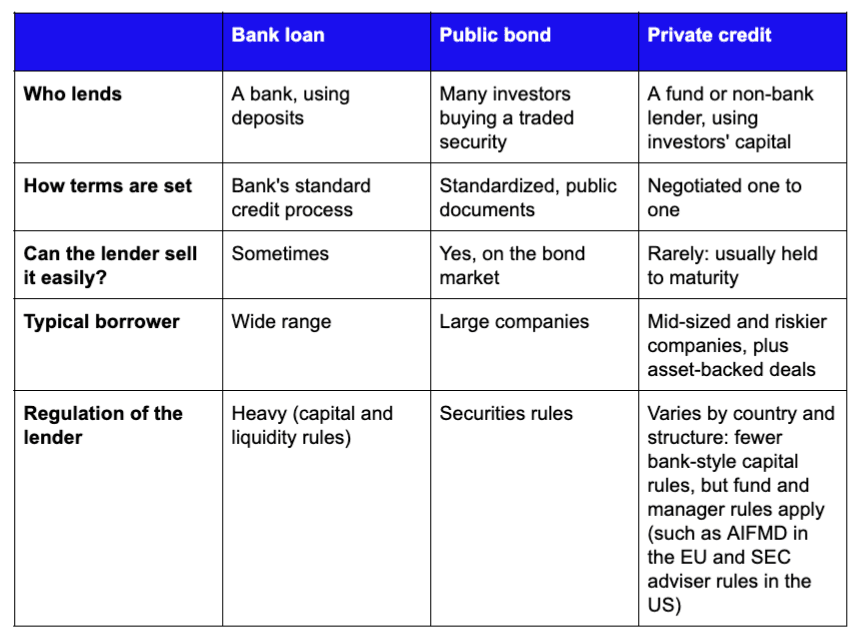
Private credit is money lent to companies by non-bank lenders (in the UK, lenders that are not banks or building societies), such as investment funds, insurers or specialist finance firms, instead of by banks or through publicly traded bonds. The loan terms are negotiated directly between lender and borrower, and the loan is usually held until it is repaid rather than traded on a market.
You will also see it called private debt. The two terms are used interchangeably, though some sources draw the boundary slightly differently. The US Federal Reserve defines it as "debt-like, non-publicly traded instruments provided by non-bank entities" to fund private businesses.
A simple way to picture it: a mid-sized software company needs $50 million to buy a competitor. Instead of going to its bank or selling bonds to the public, it borrows from a private credit fund. The fund pools money from investors such as pension funds and insurers, agrees the terms directly with the company and collects the interest over the life of the loan.
How Does Private Credit Work?
Private credit works in three layers: investors put capital into a fund or vehicle, a manager uses it to make loans to borrowers, and the borrowers' interest and principal flow back through the fund to investors after fees. The lender earns money from interest, not from owning a piece of the company. Interest is contractual, but defaults, renegotiations and restructurings can cut what investors receive.
Here is who does what:
- Investors, often called limited partners or LPs (the people and institutions who provide the capital but do not run the fund). Pension funds, insurers, endowments, family offices and, increasingly, wealthy individuals.
- The manager, or general partner (the firm that finds borrowers, checks their credit, sets terms and monitors the loans).
- Borrowers. The Fed notes private credit is typically extended to middle-market firms with annual revenues between $10 million and $1 billion, though it now also funds larger companies.
Three features make private loans different from what most people picture:
- Floating rates. The Fed says "almost all private credit loans are floating rate." The borrower pays a benchmark rate such as SOFR (the Secured Overnight Financing Rate, a US base rate) plus a fixed extra margin called the spread. If benchmark rates rise, the borrower pays more.
- Covenants. These are rules written into the loan, such as a maximum level of debt. If the borrower breaks one, the lender can step in early and renegotiate.
- Held to maturity. With no liquid market to sell into, lenders typically keep the loan until it is repaid or refinanced. The Fed puts the average maturity at around five years.
Worked example: where the interest goes (illustrative)
All numbers below are illustrative, not a forecast or a quote of any product.
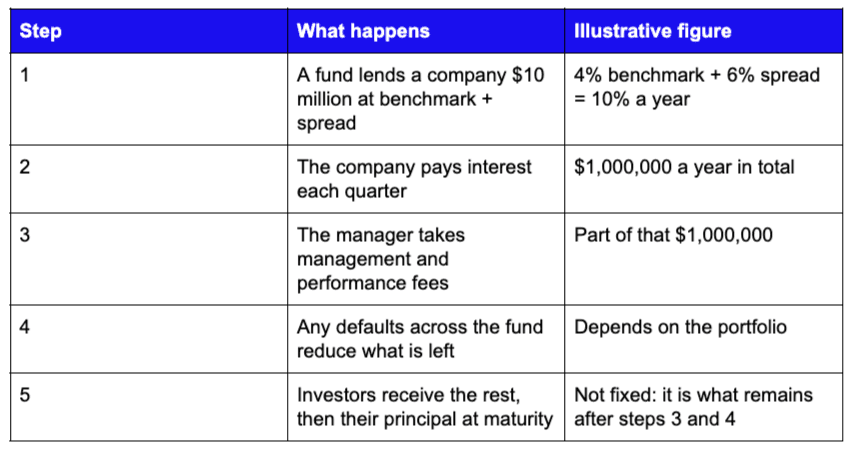
Now what? When anyone shows you a private credit return, ask which step it is measured at. The rate the borrower pays (step 1) is typically higher than what reaches the investor (step 5), because fees and any losses come out first.
Why Did Private Credit Grow So Fast?
Private credit grew largely by filling gaps banks left: after the 2008 financial crisis, banks stepped back from riskier and smaller borrowers, while companies valued the speed and flexibility of a single direct lender. Low interest rates in the 2010s also pushed investors toward it in search of income.
The Bank for International Settlements (BIS, the central bank for central banks) found in March 2025 that "post-crisis banking regulation likely reduced banks' willingness to lend to risky firms." Firms that borrowed from private credit funds valued "bespoke covenant structures and faster execution."
The shift away from bank balance sheets is visible at the level of the whole financial system. McKinsey's Global Banking Annual Review 2026 (May 2026) puts the system at $468 trillion and says the portion held on balance sheet shrank from 44% in 2022 to 40% in 2025. In its words, "In lending, private credit firms have built substantial businesses."
How big is private credit?
Different official sources give different sizes, because they measure different things:
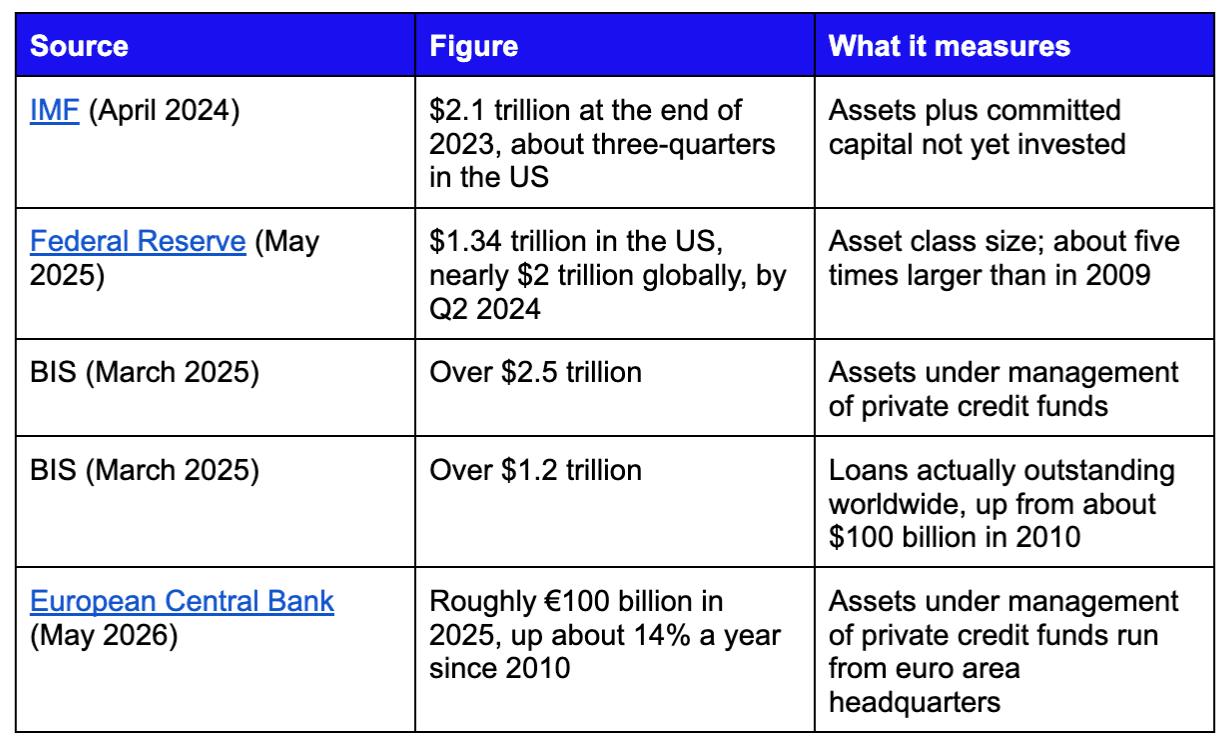
The gap between "assets under management" and "loans outstanding" matters. Part of a fund's money is committed but not yet lent (called dry powder), so headline sizes overstate what is actually lent out.
Europe is a much smaller market. The ECB puts US private credit at around $1.4 trillion at the end of 2024, or 4.7% of US GDP, while the euro area market remains small next to its bank lending and bond markets.
What Are the Main Types of Private Credit?
The main types of private credit are direct lending to companies, asset-based finance, mezzanine debt, distressed and special situations, venture debt and infrastructure debt. Direct lending is the largest: the Fed estimated it at about half of the market in 2023, and the BIS calls it the dominant strategy of the past decade.
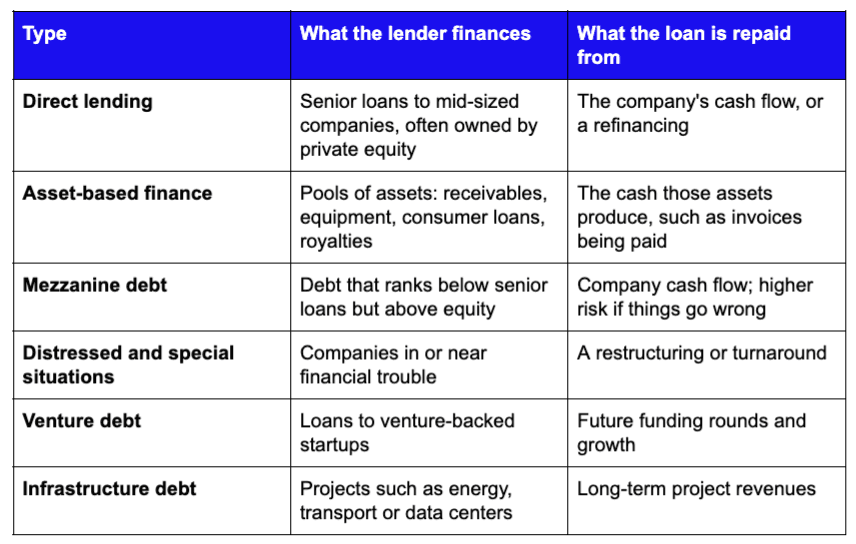
Senior means the loan gets repaid first if the borrower fails. Junior (or subordinated) means it is repaid later and takes losses first. Our guide to senior vs junior tranches and first-loss capital explains how that ordering protects some investors at the expense of others.
The difference most guides skip: duration and source of repayment
Most explainers treat direct lending and asset-based finance as two flavors of one thing. For an investor, they behave very differently.
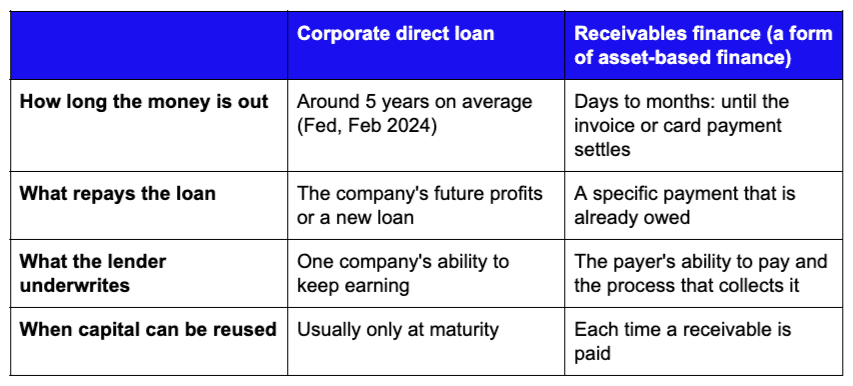
A receivable is money a business is owed for something it has already sold, like an unpaid invoice or a card payment waiting to settle. Our explainer on accounts receivable financing walks through how businesses turn those into cash today.
Now what? When you compare private credit options, look past the label. Ask what repays the loan and how long it takes. Those two answers shape your liquidity more than the headline return does.
What Are the Risks of Private Credit?
The main risks of private credit are illiquidity, borrower defaults, opaque valuations and weaker lending standards when too much money chases too few deals. Some are harder to see precisely because the loans are private.
- Illiquidity. The Fed says private credit loans are illiquid "due to the lack of a secondary market." Traditional funds can lock capital up for as long as 10 years. Semi-liquid funds offer periodic withdrawals but usually cap them. In March 2026, Bloomberg Law reported that investors sought to pull roughly $13 billion from over a dozen funds in one quarter. With withdrawals capped at 5% of net assets per quarter, more than $4.6 billion was left waiting.
- Defaults and recoveries. Borrowers are often smaller and more indebted. Floating rates mean their interest bills rise when rates rise. In February 2024, the Fed found the post-default value of a direct loan was around 33%, lower than for syndicated loans (52%) or high-yield bonds (39%).
- Valuation. Loans are not priced by a market every day. The IMF notes they are marked only quarterly using risk models, so reported values can lag reality.
- Looser standards. The IMF and the Fed both flag competition leading to weaker underwriting and fewer covenants ("covenant-lite" loans).
- Hidden leverage. Funds increasingly borrow too. A May 2025 Fed note found bank loan commitments to private credit vehicles rose from about $8 billion in early 2013 to about $95 billion by the end of 2024. The EU now sets limits: since April 16, 2026, the revised Alternative Investment Fund Managers Directive (AIFMD II) caps the leverage of EU loan-originating funds at 175% of net asset value for open-ended funds and 300% for closed-ended ones, with exposure calculated under the commitment method.
- Untested in a downturn. The Bank of England's December 2025 Financial Stability Report says private markets "have not been tested through a broad-based macroeconomic stress" at their current size. The Bank is running a system-wide stress exercise focused on them.
Now what? Before you look at the yield, find out what happens if you need your money early. If the answer is "a queue," make sure you can wait.
How Can Investors Access Private Credit?
Investors access private credit through closed-end private funds, business development companies (BDCs) in the US, European long-term investment funds (ELTIFs) in the EU, Long-Term Asset Funds (LTAFs) in the UK, semi-liquid "evergreen" funds, direct or co-investment deals, and, more recently, on-chain vaults. Each route trades off minimum size, liquidity and transparency.
For most of its history, private credit has been an institutional market. The classic route is a closed-end fund with multi-million minimums and capital locked up for years, built for pension funds, insurers and endowments. Newer vehicles have opened the door to individuals, but each comes with trade-offs: eligibility rules, notice periods, redemption caps or gates.
On-chain vaults are the newest route, aiming to make access more direct and the underlying activity easier to verify.
- Closed-end funds. The classic route for institutions. Capital is committed for years and drawn when the manager finds loans.
- BDCs. A business development company is a US vehicle that must invest mainly in smaller private companies. The BIS counts over $300 billion in BDC assets, about 20% of the US market. Some BDCs trade on stock exchanges, which gives daily liquidity in the shares, not in the loans underneath.
- ELTIFs. The European long-term investment fund is an EU fund that can lend to companies and be sold to retail investors. Its 2023 reform, which applies from January 10, 2024, removed the earlier €10,000 minimum investment for smaller retail investors.
- LTAFs. The UK Long-Term Asset Fund is an FCA-authorized open-ended fund built to hold long-term, illiquid assets, including private debt. The FCA's rules took effect in November 2021, and a 2023 update let it be sold to mass-market retail investors and self-invested pensions, with restrictions, from July 2023. Investors must give at least 90 days' notice to redeem.
- Semi-liquid funds. Open to wealthy individuals, with monthly or quarterly redemptions that can be gated, as March 2026 showed.
- On-chain private credit. Loans financed with stablecoins (crypto tokens designed to track a currency like the US dollar) through a vault, a smart contract that pools investor capital under set rules. We cover this route below and in depth in on-chain private credit explained.
What Is On-Chain Private Credit?
On-chain private credit is private credit where investor capital, loan records or repayments move on a public blockchain, usually in stablecoins. The loan is still a real-world loan with real-world risk. What changes is how capital is pooled, how fast it moves and how much of the activity investors can verify themselves.
The market is still small next to traditional private credit. On October 6, 2026, the data provider rwa.xyz tracked about $8.0 billion of tokenized credit "distributed" on public blockchains (tokens holders can transfer between wallets) and about $37.2 billion "represented" (ownership recorded on chain but not freely transferable).
Stablecoin settlement can make short-dated credit, like receivables, easier to fund and recycle. It does not remove credit risk, and it adds smart contract and stablecoin risk. That is why private credit needs a different kind of transparency.
Where Credi Fits
Credi is infrastructure for private credit: an on-chain layer that gives liquidity providers (LPs) access to high-quality private credit through vaults. Each vault feeds a credit vertical that is fully integrated with the platform. The first is on-chain receivables: payment partners originate short-dated card receivables and pay merchants before card settlement, the vault finances the partners, and the vault is repaid when that settlement arrives. A card purchase normally settles to the merchant about five days after the sale, so the capital is out for days, not the five years of an average corporate direct loan.
What sets it apart from the funds above:
- Credi does not lend to merchants directly. A payment or receivables partner always sits between Credi and the merchant.
- The repayment source is a payment already in motion, such as a card transaction waiting to settle through the card network, rather than a company's future profits.
- Capital is structured in layers, with senior and junior positions, so it is clear who absorbs losses first.
Like any private credit, this carries risk, including partner, settlement, smart contract and stablecoin risk. Total returns are not guaranteed, and Credi takes great care in the underwritting process and in setting up the required provisions to secure payments and absorb eventual losses. For the problem it solves, read why merchants wait days to get paid.
Frequently Asked Questions
Is private credit the same as private equity?
No. Private credit lends money and earns interest; it is repaid before shareholders if a company fails. Private equity buys ownership stakes and earns returns only if the company grows in value. The two often meet, since many direct loans finance private-equity-owned companies. See private credit vs private equity for a side-by-side comparison.
Is private credit the same as private debt?
Mostly, yes. "Private credit" and "private debt" are used interchangeably by regulators and managers. Both describe loans made outside banks and public bond markets and held privately. Some data providers use "private debt" for fund data and "private credit" for the broader market.
Is private credit the same as private lending?
Not quite. "Private lending" is often used for loans from private lenders to individuals or against property, such as bridging loans in the UK. Private credit usually means institutional lending to companies by funds and other non-bank lenders.
Why is it called "private"?
Because the loans are not issued or traded on public markets. The terms are negotiated privately between the lender and the borrower, the documents are not public, and there is no exchange where the price is set every day.
Can individual investors buy private credit?
Increasingly, yes, but mostly through vehicles rather than individual loans. Options include listed BDCs in the US, ELTIFs in the EU, LTAFs in the UK, semi-liquid funds with minimum investment and eligibility rules, and on-chain vaults. Each comes with its own liquidity limits, so read the redemption terms before investing.
See How Credi's Private Credit Infrastructure Works
Private credit is lending outside banks, and the type of loan decides almost everything: how long your money is out, what repays it and what can go wrong. If you want exposure to short-dated, payment-backed credit with a structure you can inspect, see how Credi's private credit infrastructure works.
This article is for information only and is not financial, investment or legal advice.


