
What Is Liquidity Risk in Private Credit?
Liquidity risk is the chance you can't get your money out when you want it. See how it works in private credit, why funds cap withdrawals, and what to check.
By CREDI Team

TL;DR
- Liquidity risk is the chance you can't turn an investment back into cash when you need it, or can only do it at a loss or after a long wait. In private credit it is usually the first risk investors feel, often well before any borrower misses a payment.
- It comes from a mismatch in timing. The loans inside a fund can take years to be repaid, while the fund promises investors they can leave every few months. When too many investors ask for their money at once, the fund has to either sell loans cheaply or make people wait.
- 2026 showed what that looks like. In the first quarter, more money left a group of large private credit funds than came in, for the first time since these funds were created, and most of those funds limited withdrawals to 5% of the fund per quarter.
- The way to reduce the risk is to line up the timing: the money you lend should come back faster than investors are promised their cash. Short-term lending, such as financing payments that arrive within days or weeks, makes that much easier.
- CREDI is built around that idea. Its vaults finance card and invoice payments that come back in days to weeks, and each investor picks a fixed lock period when depositing, so the exit date is known from day one.
Liquidity risk in one example
Imagine you own a house worth $500,000 and suddenly need $50,000 in cash this week. On paper you are well off. In practice, selling a house takes months, and selling it in a week means accepting a much lower price. The house is a good asset that is illiquid: hard to turn into cash quickly at a fair price. That gap between "what it is worth" and "what you can get for it today" is liquidity risk.
Private credit works the same way. Private credit means loans made directly to companies by funds and investors, outside the banking system and outside the stock and bond markets. These loans can be healthy and paying on time, and still be hard to turn into cash quickly.
For years, private credit sold investors a simple deal: accept that your money is tied up for a while, and in exchange earn a higher, steadier return. In 2026 many investors learned what "tied up" means in practice. The Federal Reserve's May 2026 Financial Stability Report said that certain private credit funds sold to individual investors "faced notable increases in redemption requests, and some exercised limits on the size of these redemptions." In plain words: many investors asked for their money back at the same time, and some funds only paid part of it.
This guide explains what liquidity risk is, where it comes from, how funds deal with it, and what to check before you invest, including how CREDI structures its vaults around it.
What is liquidity risk?
Liquidity risk in private credit is the risk that an investor can't get cash back out of a loan or fund when they want it, or can only get it by accepting a loss or a delay. It shows up at two levels: the loans themselves are hard to sell quickly at a fair price, and the fund holding them may limit how much investors can take out at one time.
Finance splits liquidity risk into two types, and private credit has both.
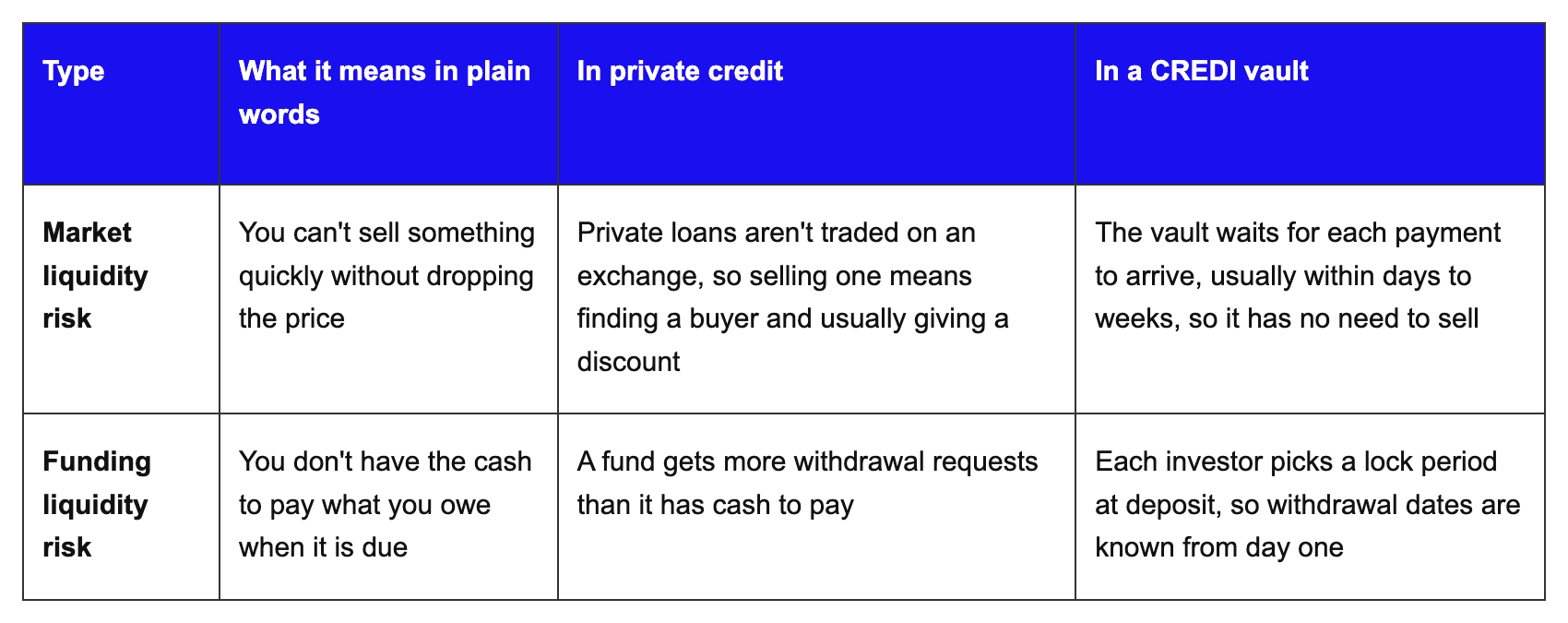
Liquidity risk is a different thing from credit risk. Credit risk is the chance a borrower doesn't pay you back. Liquidity risk is the chance you can't get your cash out in time, even when every borrower is paying. A loan can be perfectly healthy and still be illiquid, which is why an investor can lose access to their money without losing any money on paper. For background on the asset class, see our guide to what private credit is.
The mismatch between loans and withdrawals creates the risk
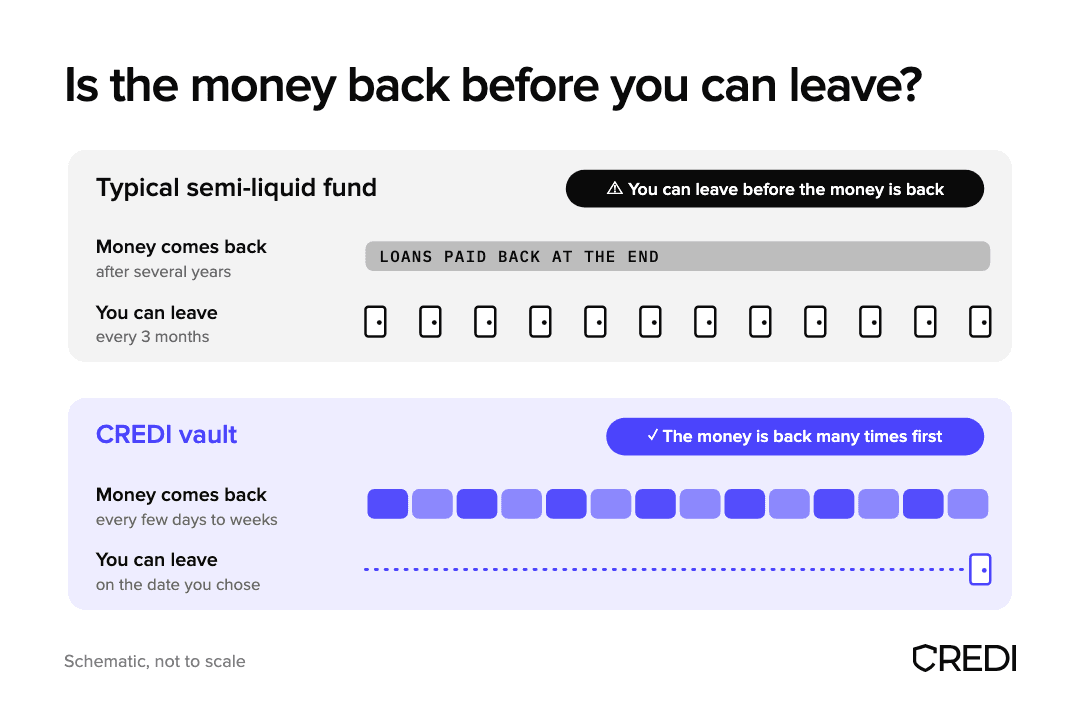
Liquidity risk turns into a real problem when investors are promised faster access to their cash than the loans can deliver. A typical private loan to a mid-sized company lasts several years, and most of the money comes back at the end. If the fund holding that loan lets investors withdraw every three months, it has made a promise its loans can't keep on their own. Finance calls this a maturity mismatch: money that is lent for a long time, funded by money that can leave on short notice.
Most traditional private credit funds avoid the mismatch with a simple rule: investors commit their money for the whole life of the fund, often seven to ten years, and get paid back as the loans are repaid. The IMF's April 2024 Global Financial Stability Report found that most private credit funds carried little of this risk, and pointed at the newer fund types as the concern.
"growth of semiliquid and retail-facing funds increases redemption and first-mover risks"
International Monetary Fund, Global Financial Stability Report, Chapter 2, April 2024
A semi-liquid fund is one that accepts new money all the time and lets investors leave at set moments, such as once a quarter. The best-known examples in the US are business development companies (BDCs), which are listed or unlisted funds that lend to mid-sized companies, and interval funds, which allow withdrawals at fixed intervals. According to the Federal Reserve, semi-liquid funds held about 20% of the money in private credit funds as of May 2026. Their setup works well while more money comes in than goes out. When that flips, the mismatch shows.
CREDI's vaults put the two clocks in the opposite order. The loans are short: they finance payments that arrive in days to weeks. The investor's commitment is longer: a lock period of months, chosen at deposit. During one lock period, the same money in the vault is lent, repaid and lent again many times, so the vault doesn't depend on new deposits to pay investors who are leaving.
There is one more reason a rush for the exit can grow. Private loans have no daily market price, so a fund's reported value can lag behind what the loans are really worth. If the loans have quietly lost value, the investors who leave first get paid at the old, higher price, and those who stay carry the losses later. This is called a first-mover advantage, and it gives everyone a reason to ask for their cash early. A small wave of withdrawals can turn into a large one.
2026 showed how withdrawal limits work in practice
In the first quarter of 2026, the money investors took out of the largest open-ended private credit funds was greater than the new money coming in, for the first time since these funds were created, according to the Federal Reserve. Some funds received withdrawal requests far above their usual limits, and most chose to pay out only part of what was asked.
Two terms explain how this works:
- Redemption is the finance word for taking your money out of a fund.
- A redemption cap, also called a gate, is the maximum the fund will pay out in one period.
Most of these funds said they would limit total withdrawals to 5% of their net asset value (NAV) per quarter. NAV is simply what everything in the fund is worth, minus what the fund owes. When requests go above the cap, everyone who asked gets a share of that 5%, and the rest of their request waits for the next quarter.
Here is a worked example with illustrative numbers.
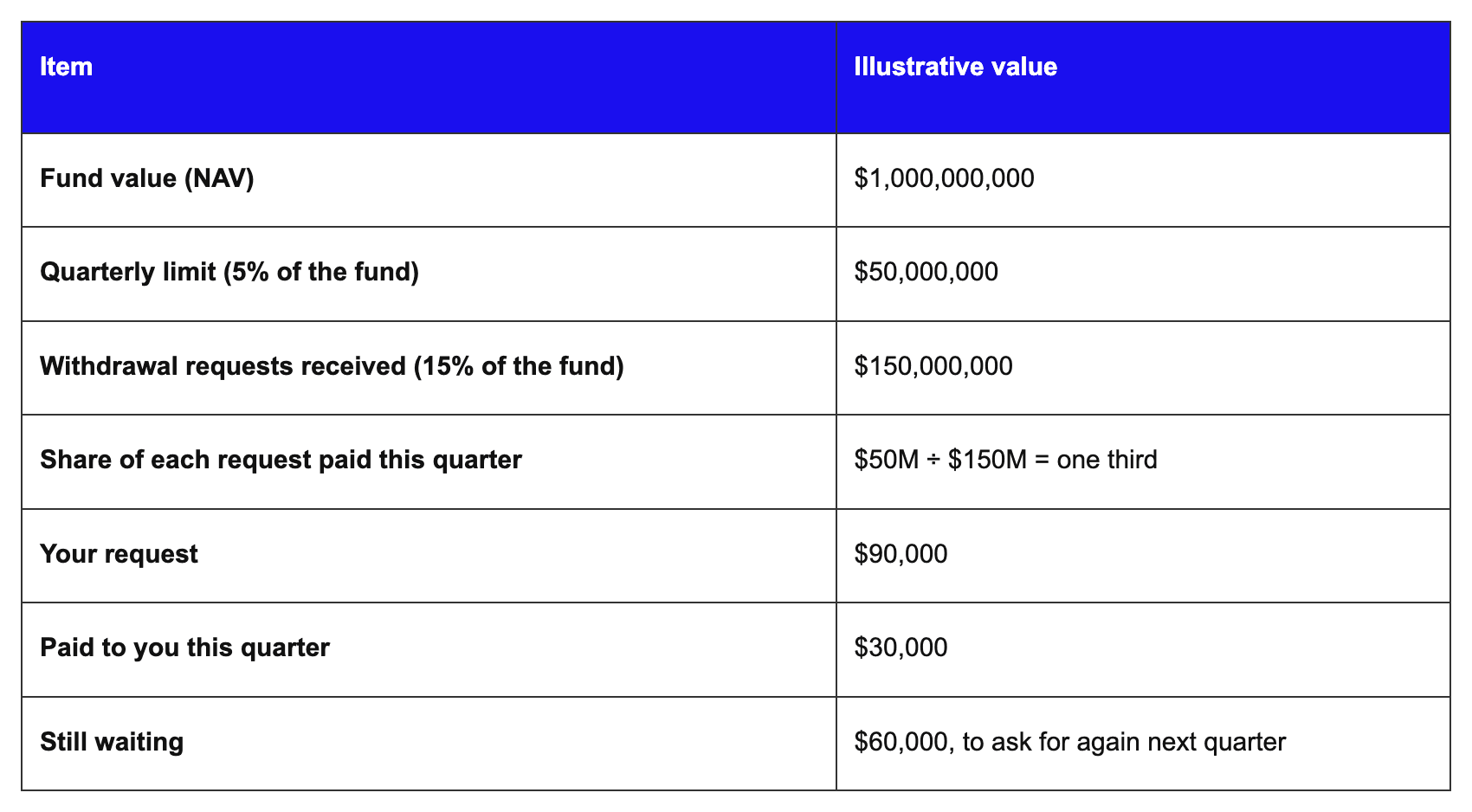
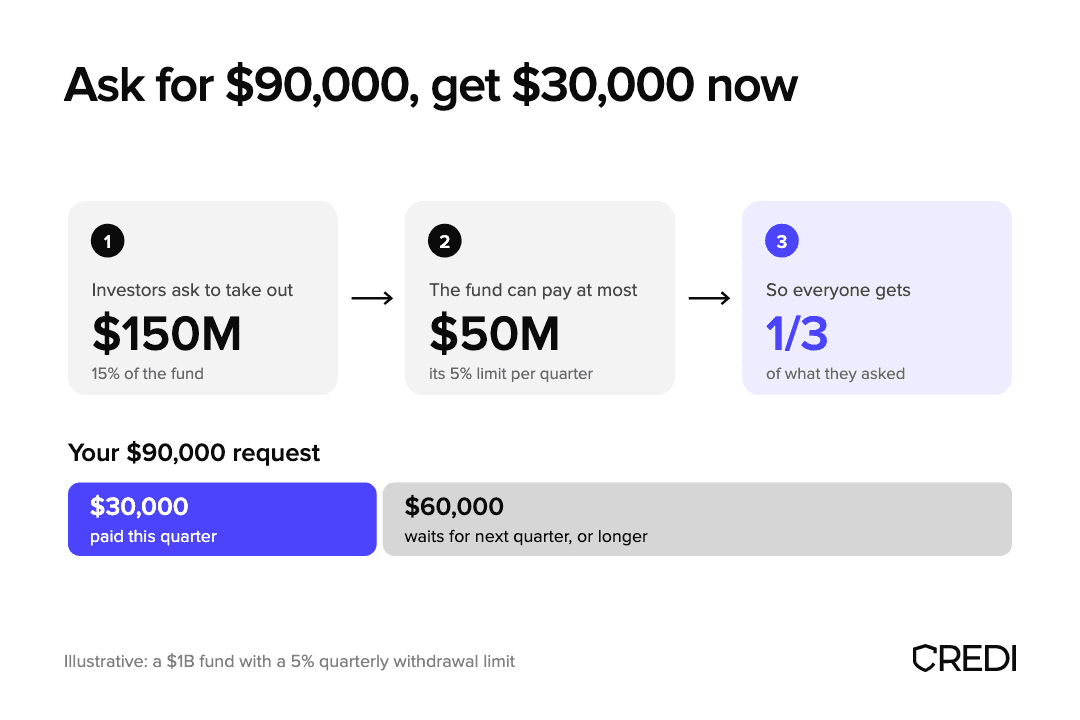
If requests stay at the same level, getting the full $90,000 out can take several quarters. No borrower has failed to pay, and yet your money isn't there when you planned to use it.
This is the situation CREDI's structure is designed to avoid. A CREDI investor agrees on the exit date when depositing, so there is no quarterly line to wait in and no payout cut down because other investors asked at the same time. The trade-off is set in advance: the money stays in the vault until the chosen lock period ends.
The Fed called the risk to the wider financial system "limited and manageable," noting that the 10 largest of these funds had enough cash and bank credit to cover at least three quarters of withdrawals at the 5% level. That is about the system as a whole. An individual investor who needed the cash that quarter still had to wait, and the European Central Bank's May 2026 review described the same funds as "hit by sizeable redemption requests since the beginning of 2026."
Funds manage liquidity risk with a short list of tools
Every private credit fund manages liquidity with some mix of the same tools: rules on when investors can leave, cash kept aside, the ability to borrow, and loans that pay back bit by bit. The mix decides how much of the liquidity risk ends up with you, the investor.
- Lock periods: you agree not to withdraw for a set time, so the manager can lend for that same length of time.
- Redemption caps and gates: a limit on how much can leave per period. They protect the investors who stay, and delay the ones who want out.
- Notice periods: you have to ask weeks or months before you can withdraw.
- Cash buffers: part of the fund kept in cash or similar, ready to pay withdrawals. Cash earns less, so returns go down a little.
- Credit lines: a pre-agreed loan from a bank that the fund can draw to pay investors. It costs interest and adds leverage, meaning the fund is running partly on borrowed money.
- Natural amortization: loans that repay a part of the amount regularly, like monthly mortgage payments, so cash comes back without selling anything.
CREDI relies on two of these tools. Lock periods set each investor's exit date up front, and natural repayment does the rest: every payment a vault finances is repaid when the payment arrives, so cash flows back into the vault on a short cycle without selling anything.
Banks face the same problem with deposits, because customers can withdraw at any time. Regulators answered with rules. Under the international banking rules known as Basel III, banks must hold enough high-quality liquid assets, meaning cash and assets that are easy to sell, to get through 30 days of heavy withdrawals. Private credit funds have no single rule like this, which is why reading each fund's own terms matters so much.
Asset duration decides how much liquidity risk you carry
The faster the loans come back as cash, the less liquidity risk an investor carries for the same exit terms. Finance calls this time duration. A fund holding five-year loans has to sell loans, borrow or limit withdrawals to handle a wave of exit requests. A fund holding loans that repay within weeks gets a steady flow of cash back from repayments alone.
Most explanations of liquidity risk skip this point: the caps, the locks and the cash buffers are all patches on top of one number, how long it takes the loans to turn back into cash. Compare the two cases.
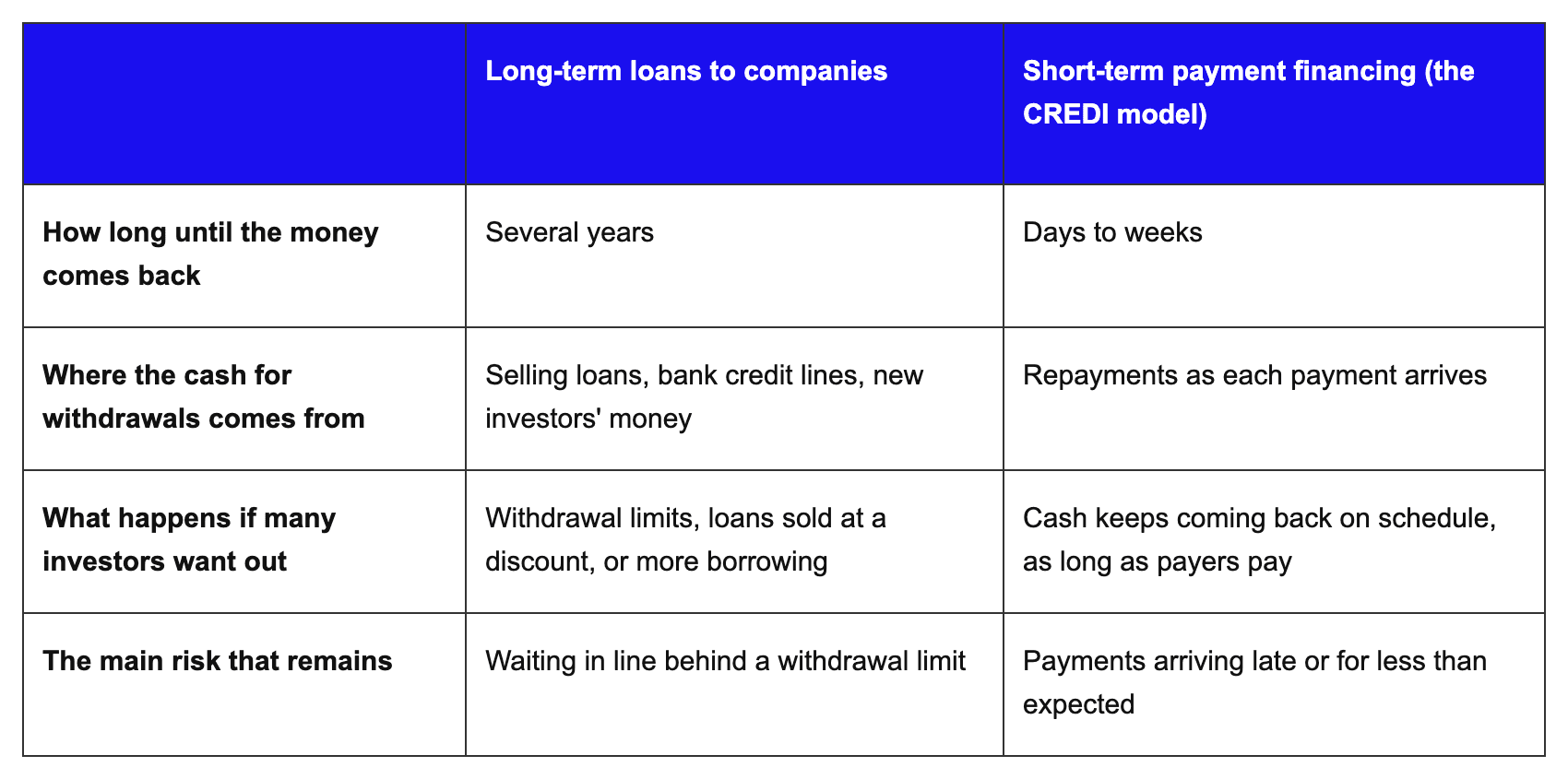
Short duration still leaves some liquidity risk. If payers pay late, or a company in the payment chain has problems, cash can come back slower than expected. What it changes is where the cash comes from: scheduled repayments that arrive every few days or weeks. Onchain reporting helps too. Because the vault's activity is recorded on a public blockchain, investors can follow repayments as they happen. We cover that in why private credit needs a different kind of transparency.
What to check before you commit capital
Before investing in any private credit product, write down three things: when you can get your money back, under what conditions, and what happens if everyone asks at once. These terms are in the fund documents, and they matter as much as the yield. Use the table as a quick checklist.
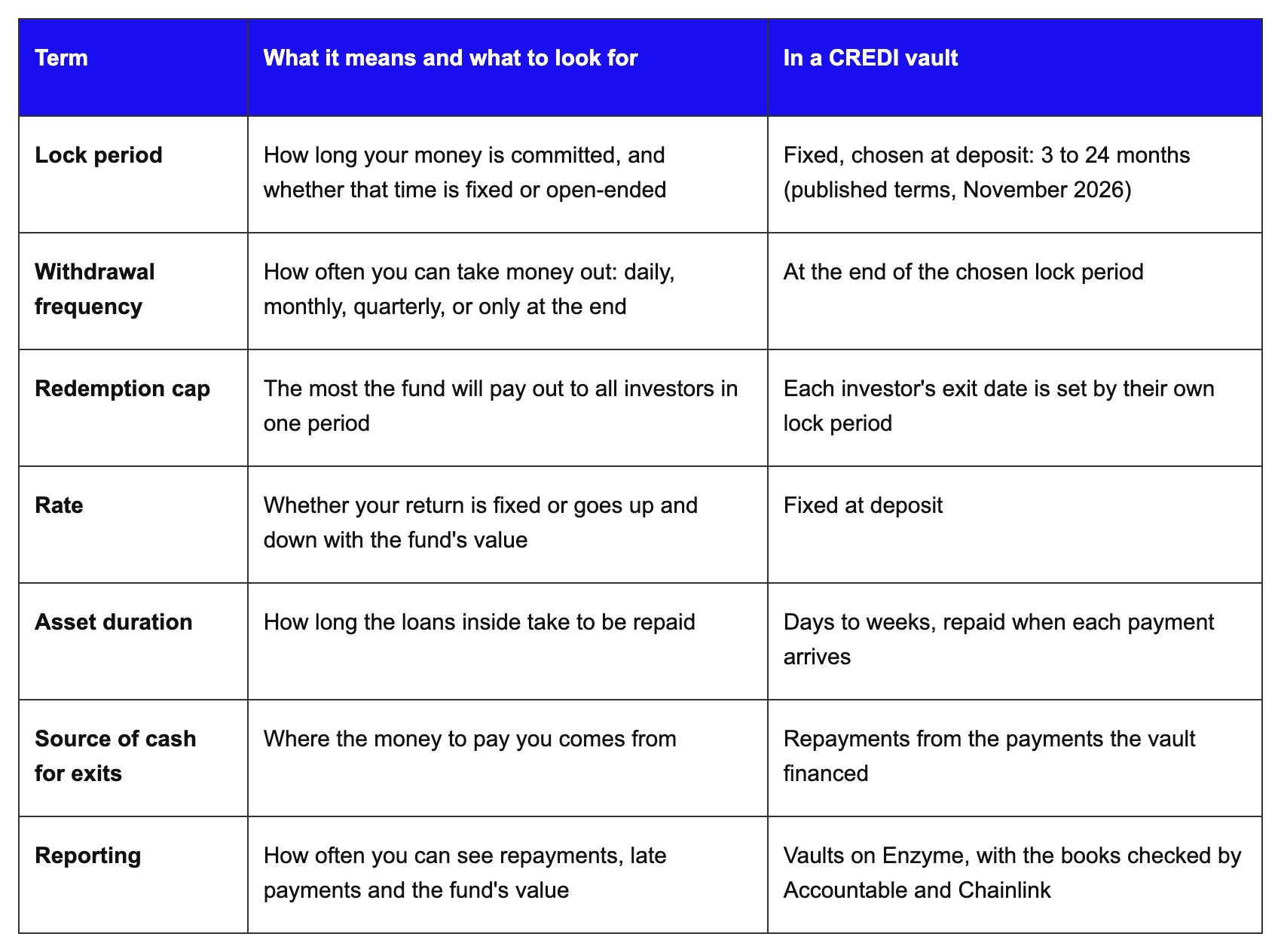
A useful rule: never put money into a private credit product that you might need before its realistic exit date, and be careful with any promise to give you your money back faster than the loans themselves repay. A high yield on money you can't reach when you need it can cost more than it pays, a point we expand on in the illusion of yield.
Where CREDI fits
CREDI is infrastructure for private credit: an onchain layer that gives investors, called liquidity providers (LPs), access to private credit through vaults. A vault is a pool of money run by code on a blockchain, with fixed rules for deposits and withdrawals. LPs deposit stablecoins such as USDC, digital dollars designed to stay worth $1. The return comes from financing receivables, which is money a business is owed and waiting to receive, such as card payments and invoices. The financing is repaid when the payment arrives, typically in days to weeks. CREDI connects LP money to those receivables, with a payments partner such as Paymesh in between.
Every section of this guide comes back to the same design choice. In liquidity terms, CREDI lines up the two clocks:
- How fast the money comes back: receivables are repaid in days to weeks, so money in the vault returns on a short cycle.
- When investors can leave: LPs choose a lock period when they deposit (3 to 24 months under CREDI's published vault terms as of November 2026), and the rate is fixed at deposit. The exit date is known from day one.
- What investors can see: vaults run on Enzyme vault infrastructure on Ethereum, and the books are attested, meaning independently checked and confirmed, by Accountable and Chainlink. Anyone can verify repayments.
Liquidity risk still applies. Money can't be withdrawn before the end of the chosen lock period, payments can arrive late or for less than expected, the companies in the chain carry counterparty risk (the chance that one of them fails to do its part), and the vault's code carries technical risk. CREDI vaults are not risk free. For a broader look at how this model works, see what onchain private credit is.
Frequently Asked Questions
Is private credit a liquid investment?
No. Private loans aren't traded on an exchange, so they can't be sold quickly at a predictable price. Some private credit funds offer withdrawals every few months, but with limits and advance notice. Treat private credit as money committed for a set time, and only invest what you won't need before that time ends.
What is a redemption gate?
A redemption gate is a limit on how much money investors can take out of a fund in a given period, often 5% of the fund's value per quarter in semi-liquid private credit funds. When requests go above the limit, each investor gets part of what they asked for, and the rest is pushed to later periods.
Is liquidity risk the same as credit risk?
No. Credit risk is the chance that a borrower doesn't pay back. Liquidity risk is the chance that you can't get your cash when you need it, even if every borrower is paying. The two are linked, since rising defaults often lead more investors to ask for their money, but a fund can run short of cash with a perfectly healthy set of loans.
How does a lock period reduce liquidity risk?
A lock period commits your money for a known time, so the manager can lend for that same time and doesn't need to sell loans to cover surprise withdrawals. For you, the deal is clear in advance: no access before the end date, and no risk of other investors rushing for the exit during the lock.
Can I withdraw from a CREDI vault before the lock period ends?
No. Money in a CREDI vault stays in until the end of the lock period chosen at deposit (3 to 24 months under published terms as of November 2026). That makes picking the lock period the main liquidity decision for a CREDI LP: choose a period that ends before you expect to need the cash.
How does CREDI reduce liquidity risk for its LPs?
By pairing short-term lending with fixed commitments. Vaults finance payments that arrive in days to weeks, LPs commit for a lock period set at deposit, and the rate is fixed at deposit too. Exit dates are known in advance, and repayments can be followed through onchain reporting that is independently checked. Payments can still arrive late, so some liquidity risk remains.
Can I sell a private credit fund position early?
Sometimes, but rarely at full value. Some funds let you transfer your stake to another investor with the manager's approval, and specialist buyers purchase fund stakes, usually at a discount. Never count on an early exit. Plan as if your money stays in until the stated exit date.
Plan your exit before you chase the yield
Liquidity risk comes down to one question: when can you get your money back, and what could delay it? Match the fund's exit terms to your own timeline, and favor structures where the loans repay faster than investors are promised their cash. To see how CREDI pairs short-term receivables with fixed lock periods and independently checked onchain reporting, explore CREDI →
This article is for information only and is not financial, investment or legal advice.


