

TL;DR
- Merchant settlement is the process that moves money from a cardholder's bank to a merchant's bank account after a card sale. Approval takes seconds. The money usually takes days.
- Six parties touch every card payment: the cardholder, the merchant, the acquirer (the merchant's bank), sometimes a payment facilitator, the card network and the issuer (the cardholder's bank). When a merchant gets paid early, a seventh joins: the capital that funds the advance.
- The delay comes from batching, net settlement between banks, business-day calendars and risk holds for refunds and disputes. For a US account, Stripe's default payout timing is 2 business days after the payment; in most EU countries and the UK it is 3.
- For a small business, the delay is a standing balance of its own money in transit, and that balance grows with sales.
- Early settlement closes the gap: the merchant receives payment for approved sales right away, and the card settlement repays the capital later. CREDI finances that settlement cycle with private credit from liquidity providers.
What Is Merchant Settlement?
Merchant settlement is the process that turns an approved card payment into cash in the merchant's bank account. After the issuer approves a sale, the transaction is batched, cleared through the card network, settled between banks and paid out to the merchant, minus fees. Authorization takes seconds; merchant settlement typically takes one or more business days.
"Merchant settlement" also appears in news about the Visa and Mastercard swipe-fee class action. This article covers the daily payout of card sales. On a bank statement, a line such as "merchant settlement" is usually your payment provider's payout of card sales, net of fees, and the reference shows which provider sent it.
Here is the core idea in one sentence. When a customer taps a card, the merchant hands over the goods immediately and gets paid later, so every card-accepting business is quietly funding a short gap in the payment system.
That gap is the reason CREDI exists. Each gap is a short, known amount of money owed by the card system, and it can be financed. CREDI connects that gap with liquidity providers who want to fund it, working with specialist partners across payments, vault infrastructure and data. The rest of this article follows the gap step by step and shows where that capital comes in.
Who Is Involved in a Card Payment?
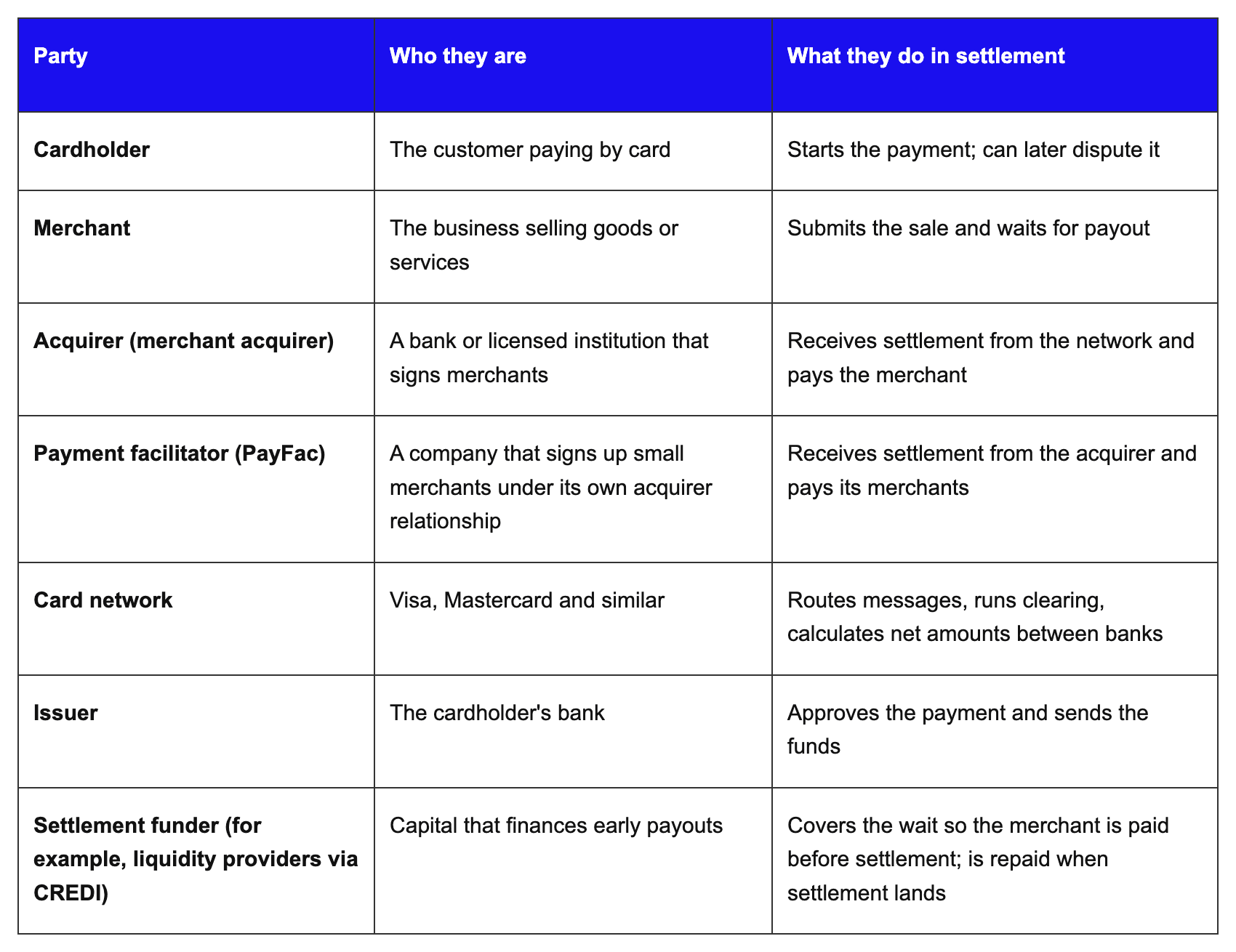
A single card payment passes through up to six parties, and each one has a different job in getting money to the merchant. When the merchant opts into early settlement, a funder joins the chain. The two parties that confuse people most, the acquirer and the payment facilitator, are defined below the table.
What is a merchant acquirer?
A merchant acquirer is the bank or licensed institution that lets a business accept card payments and pays out the money from those payments. Visa's rules define an acquirer as a member that "signs a Merchant or Payment Facilitator" and enters transactions into the network (Visa Core Rules, April 2026). In practice, the acquirer is the party that owes the merchant its money.
What is a payment facilitator?
A payment facilitator is a company that signs up many small merchants under one acquirer relationship, so each merchant does not need its own merchant account. Visa defines it as an entity that contracts with an acquirer to deposit transactions and receive settlement on behalf of a "Sponsored Merchant." Visa's rules also say a payment facilitator that receives payment from an acquirer must pay its merchants "promptly after Transaction Deposit."
Where CREDI sits in this chain
CREDI goes to market through the payment companies that sit between merchants and their acquirer, so the merchant keeps dealing with the provider it already knows. Behind that offer, CREDI finances the settlement cycle with liquidity providers' capital. For a live example, read CREDI x Paymesh: Financing the Wait Between a Swipe and a Settlement.
Now what? If you accept cards, check whether your contract is with an acquirer directly or with a payment facilitator. That contract sets your payout schedule.
Follow One Card Payment From Tap to Bank Account
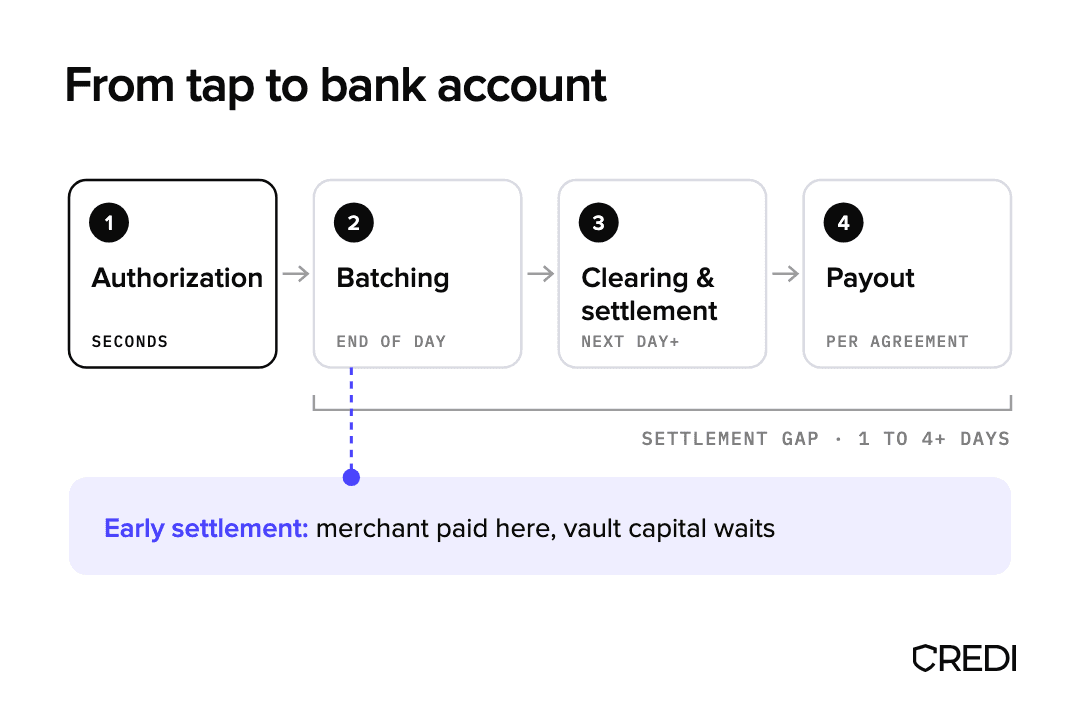
A card payment moves through four stages: authorization, batching, clearing and settlement, then payout to the merchant. Only the first stage happens in real time. The rest run on cycles, cutoffs and business days.
1. Authorization (seconds). The terminal sends the payment to the acquirer, which routes it through the card network to the issuer. The issuer checks the account and approves. Visa's rules describe authorization as "a process where an Issuer" approves a transaction. At this stage, the issuer has only made a promise to pay.
2. Batching (end of day). The merchant's approved sales are grouped and submitted together, usually once a day. A sale at 9 a.m. and a sale at 6 p.m. often enter the same cycle.
3. Clearing and settlement (next business day or later). Clearing is the exchange and valuation of transaction records between the network and its member banks. Settlement is the actual funds transfer. Visa defines its "Settlement Amount" as the daily net amount each bank owes after clearing, so banks settle one net figure covering millions of payments.
4. Payout (when the merchant agreement says so). The acquirer or payment facilitator credits the merchant, net of fees. Visa notes that merchants pay interchange (the fee passed from the acquirer's side to the issuer) indirectly, through a "merchant discount" paid to their provider, typically a percentage per transaction (Visa, Rates, Fees and Rules). In the EU, interchange on consumer cards is capped at 0.2% of the transaction for debit and 0.3% for credit under the EU Interchange Fee Regulation (EU) 2015/751.
Where early settlement changes the path
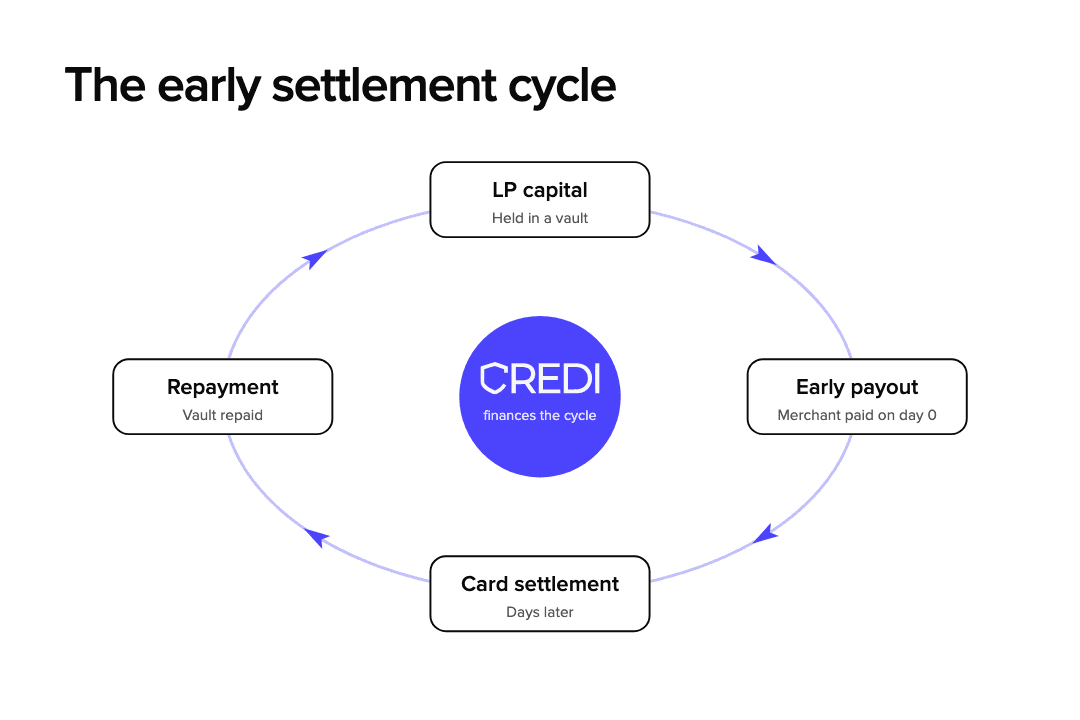
With early settlement, stages 1 to 3 stay exactly the same. Stage 4 moves forward: once a sale is approved and batched, the merchant can be paid right away, with liquidity providers' capital covering the wait. When stage 3 completes on the network's normal schedule, the settlement goes to repay the vault. The merchant gets its money at the start of the gap, and the vault carries the wait in between.
The settlement timeline, day 0 to day N (illustrative)
The table below follows one payment made on a Friday evening at a US shop whose provider pays out 2 business days after the payment. The last column shows the same sale with early settlement funded by vault capital. These timings are illustrative. Real timings depend on the provider, the merchant's risk profile and the contract.
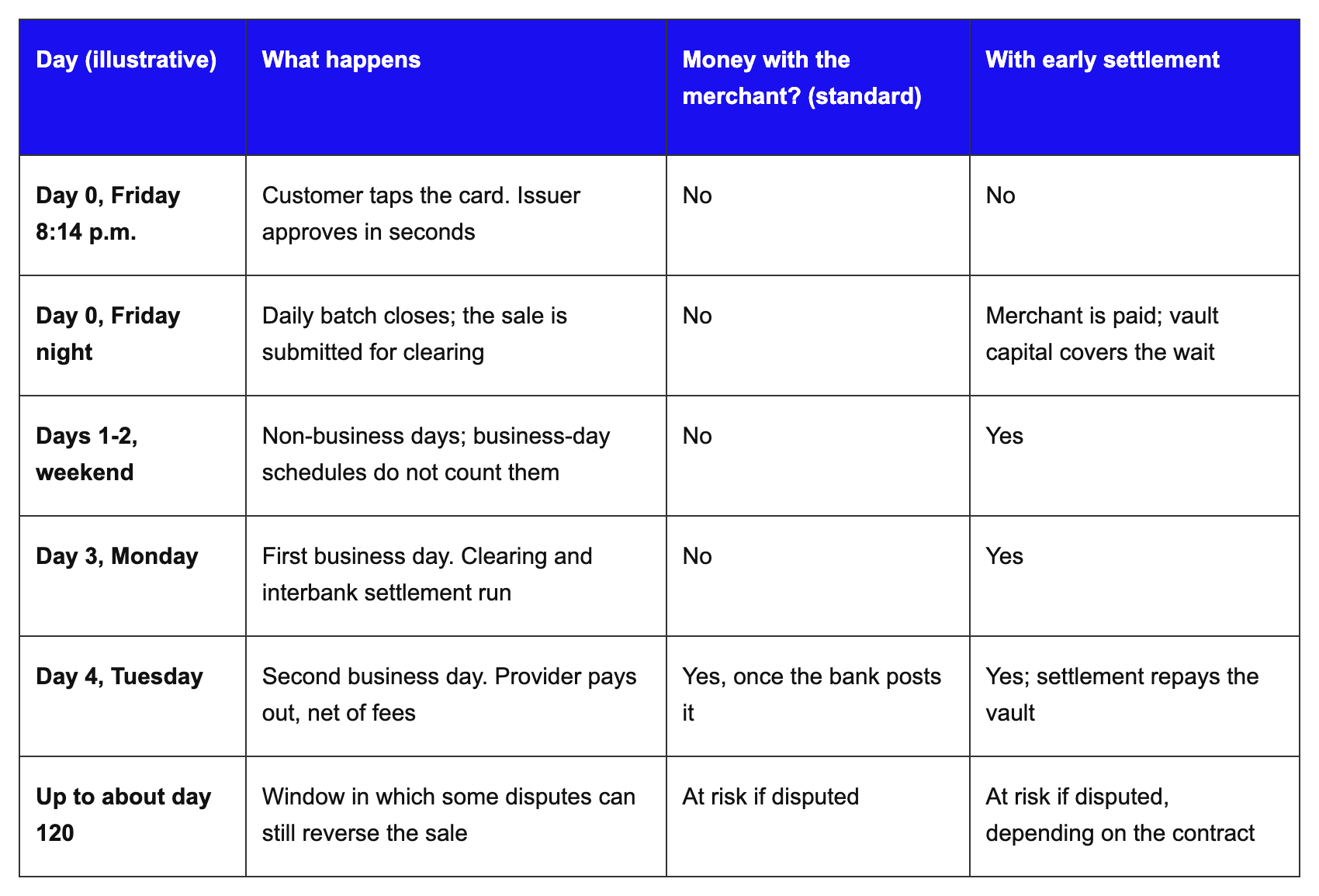
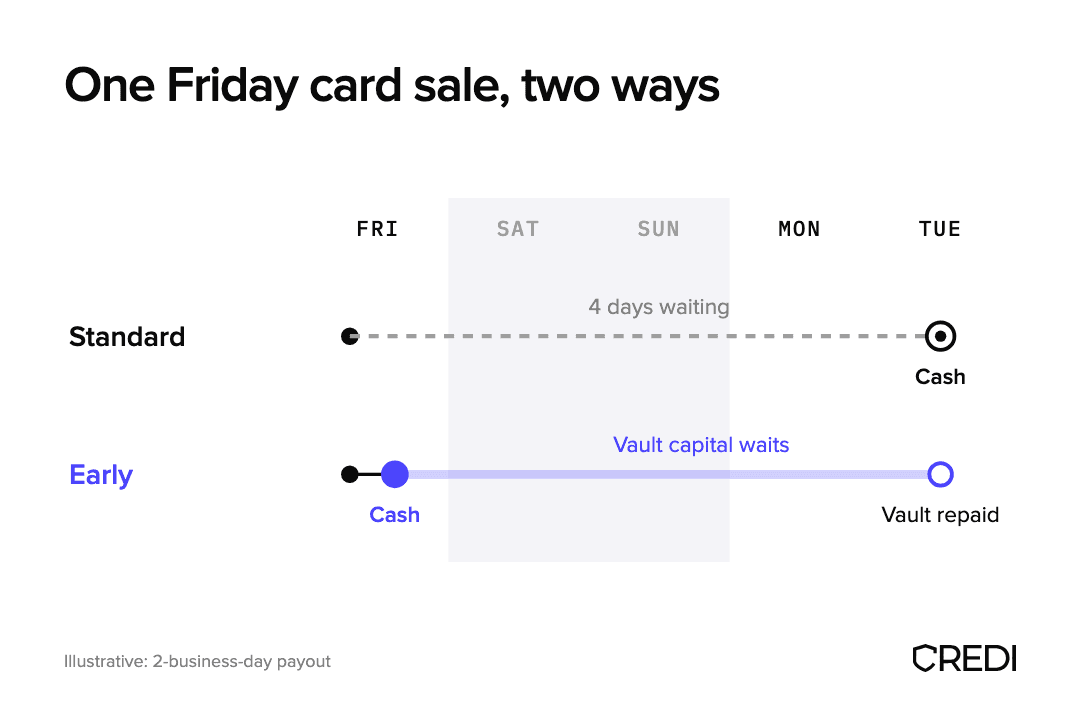
The weekend effect: a Friday sale on a "2-day" schedule is a 4-calendar-day wait. On a long holiday weekend, it can be 5 or more. Rent, payroll and suppliers are paid in calendar days, so the business-day count understates the wait. Those calendar days are also the term of the financing behind early settlement.
Why Does Card Settlement Take Days?
Card settlement takes days because the system runs on batches, net settlement between banks, business-day calendars and risk holds. Each one protects someone, and the merchant pays for that protection in time.
- Batching and cutoffs. Sales are grouped and submitted once a day. Miss the cutoff and the sale waits for the next cycle.
- Net settlement between banks. Networks calculate one net amount per bank per day. That is cheaper and safer than moving every payment separately, and it ties merchants to the daily cycle.
- Business days. Stripe, for example, counts US payout delays in business days, Monday to Friday.
- Risk holds for new or riskier merchants. Stripe says a first payout typically completes within 7-14 days "depending on your industry, country of operation, and risk level," and that risk criteria can keep an account on slower timing.
- Disputes and refunds. A cardholder can dispute a payment long after the sale. For some fraud disputes, Visa's rules give the issuer 120 calendar days from the processing date. Providers hold back time, and sometimes reserves (a share of sales kept back to cover future disputes), to make sure they can recover that money.
Faster rails are arriving, but slowly. HSBC's Global Payment Trends Report 2026 (June 2026) notes that "real-time payments remain mostly domestic," even as cross-border demand rises (HSBC).
What financing can and cannot speed up
Batching, net settlement and business days are timing rules. They delay money that is already approved and on its way, and that is the part a funder can bridge: the merchant is paid now, and the card network's settlement repays the vault later. Disputes and refunds are credit risk. They stay with the sale whoever funds it, which is why the contracts decide who carries dispute losses before any capital moves.
How Long Does Merchant Settlement Take?
Merchant settlement usually takes one to a few business days after the sale, and longer for new accounts. The exact time is set by the provider and the merchant agreement. Published processor terms give a useful reference point.
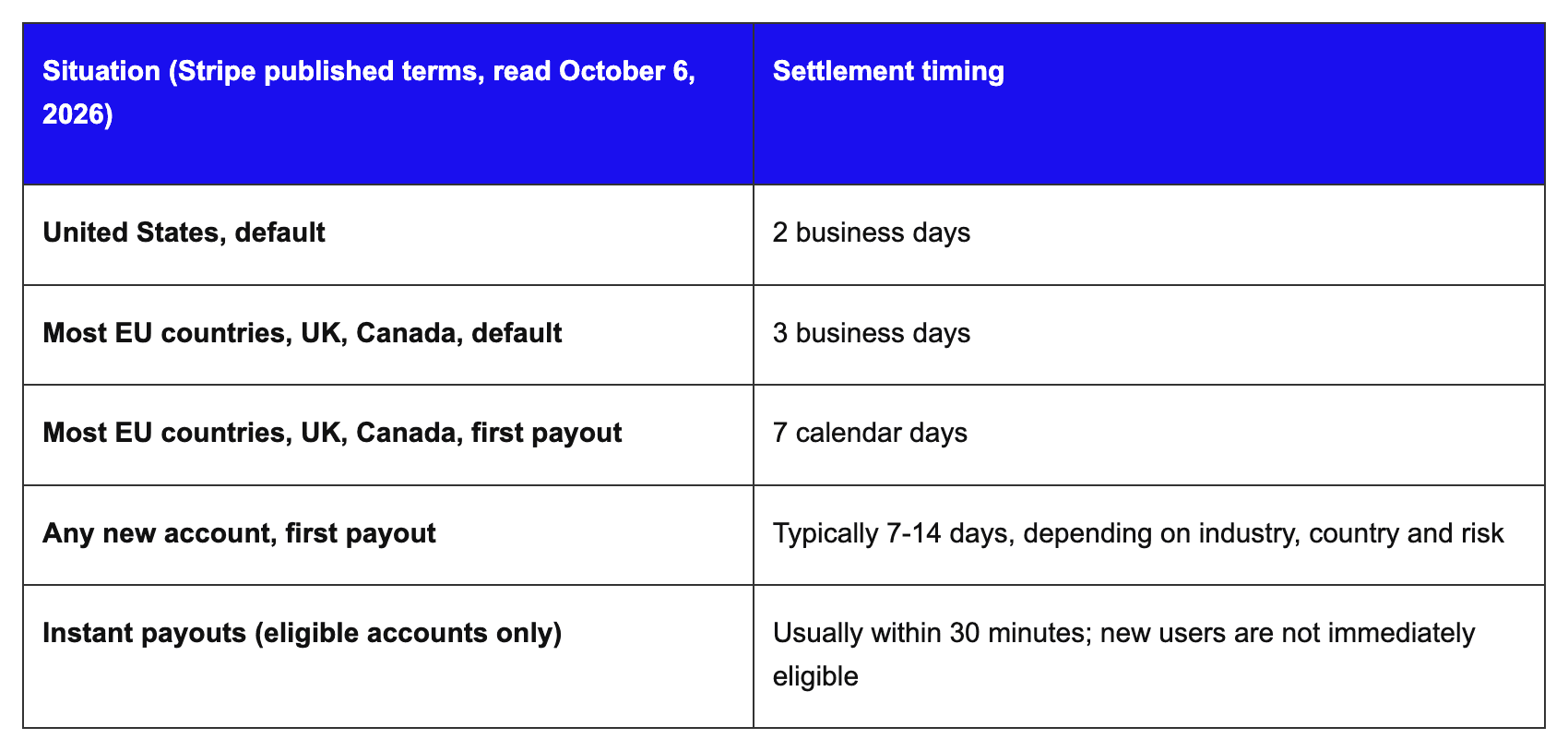
Source: Stripe payouts documentation (linked above). Other providers publish different schedules, so treat this as one example.
For a funder, these numbers describe the length of the loan. Card settlement gaps are measured in days, and each one ends with a known payer settling a known amount. Short, repeating terms like these are what make card settlement a good fit for private credit: capital in a vault structured by CREDI is lent for days, repaid by settlement and then lent again to the next batch of sales.
Now what? Look for two numbers in your agreement: the settlement timing (how long until funds are available) and the payout schedule (how often they are sent). Stripe treats these as separate settings, and many merchants only notice the second one.
Is settlement faster in Europe and the UK?
Not for card payouts. Stripe's published default for most EU countries and the UK is 3 business days, one more than in the US.
EU law is strict about the bank side: for euro payments, the Payment Services Directive (PSD2), Articles 83 and 87 requires the payer's provider to credit the payee's provider by the end of the following business day, and the payee's provider to make the money available immediately after that. Payout schedules, holds and reserves are set in your provider agreement, so the table above is the better guide to when cash actually lands.
Instant rails exist for bank transfers. Under the EU Instant Payments Regulation (EU) 2024/886, euro instant credit transfers must be available 24 hours a day on any calendar day, and a transfer not confirmed within 10 seconds goes back to the payer. In the UK, Pay.UK says Faster Payments are usually available almost immediately, though some can take up to two hours.
Card sales still follow the batching, clearing and settlement cycle described above. That is why the merchant's wait exists on both sides of the Atlantic, and why the financing model CREDI supports applies in both markets.
What Does the Settlement Delay Cost a Small Business?
The settlement delay costs a merchant a permanent balance of its own money in transit, roughly equal to daily card sales multiplied by the days of delay. It shows up as a smaller bank balance, which is why it is easy to miss.
Worked example (illustrative)
Take a café that sells $6,000 a day by card, seven days a week, on a 2-business-day payout schedule. Assume each day's sales are paid out on the second business day and nothing is held back. All numbers are illustrative.
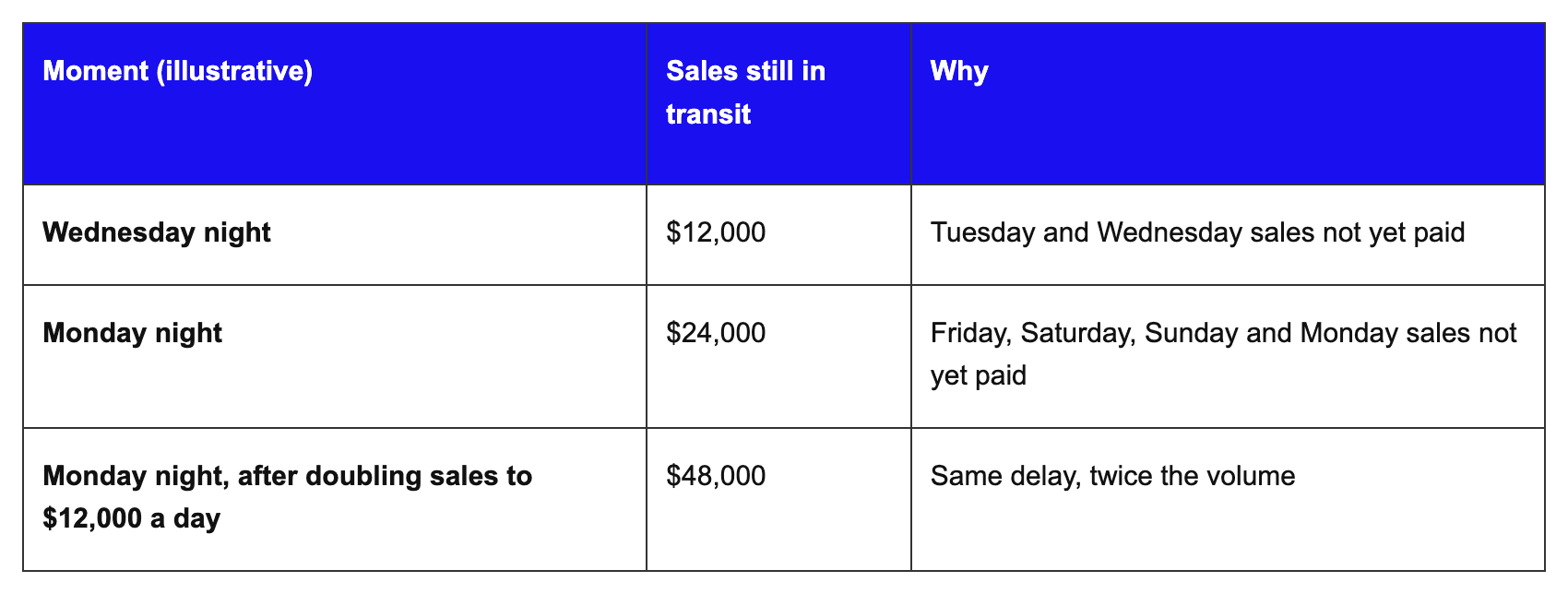
- The gap is permanent. Tomorrow's sales replace today's, so a standing balance is always in the pipeline.
- Weekends double it. The worst cash day for a seven-day business is often Monday, right when weekly suppliers and payroll come due.
- Growth consumes cash. Double the sales and you double the money stuck in transit. A business can be more profitable and less liquid at the same time.
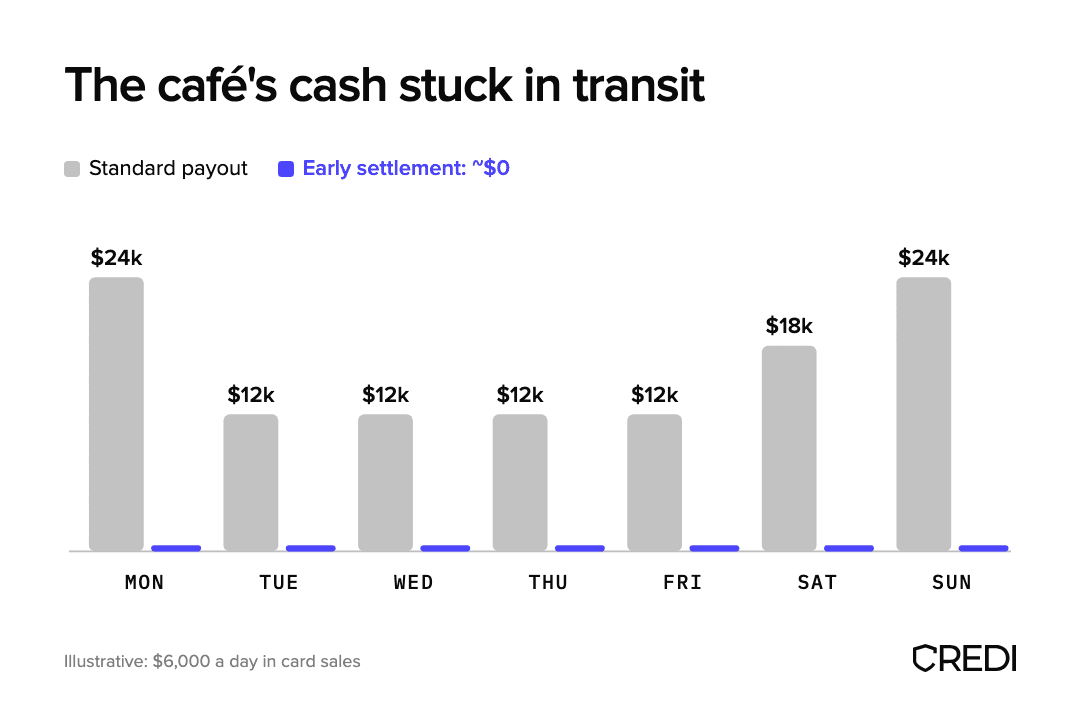
Now picture the same café with early settlement. Monday's $24,000 is in the café's account on Monday, minus a fee for the service. Vault capital covers those four days, and Tuesday's card settlement repays it. The café's standing balance in transit drops to close to zero, and the same $24,000 of vault capital moves on to fund the next set of sales.
In the Fed's 2026 Small Business Credit Survey report (March 2026), meeting operating expenses was the most common reason employer firms sought financing, cited by 56% of them (Federal Reserve Banks). The scale is large too: the US saw 67.1 billion credit card payments and 120.6 billion debit card payments in 2024 (Federal Reserve Payments Study, July 2026). In the euro area, there were 47.8 billion card payments in the second half of 2025 alone, 7.9% more than a year earlier (ECB payments statistics, July 2026). Every one of those payments opens a settlement gap, and together they form one of the largest pools of short-term receivables in the economy.
Now what? Work out your own figure: average daily card sales times your longest regular delay in calendar days. That is the cash you need to carry just to stand still, and the amount early settlement would release.
How Does Faster Settlement Get Funded?
Faster settlement is funded when capital covers the merchant's payout before the card network settles and is repaid when the settlement lands. The card network settles on its normal schedule, and the funder carries the wait for the merchant.
This is a form of receivables finance. A receivable is money a business is owed but has not yet received. A card settlement receivable has an unusual profile: the sale has happened, the card was approved, the amount is known, and the payer is the card settlement system. That profile is why settlement gaps attract short-term funders, and why CREDI chose card settlement as its first fully integrated vertical. We cover the wider family of products in accounts receivable financing explained.
The funder takes on risk. The main risks are:
- Disputes and refunds. If a sale is reversed, the expected settlement is smaller than the advance.
- Payment chain risk. The funder relies on the companies in the payment chain to route settlement correctly and on time.
- Operational risk. Delays, errors or fraud in the payment chain can slow or reduce repayment.
- Concentration. Exposure to a few partners or merchant types can amplify any of the above.
Here is how the main options compare.
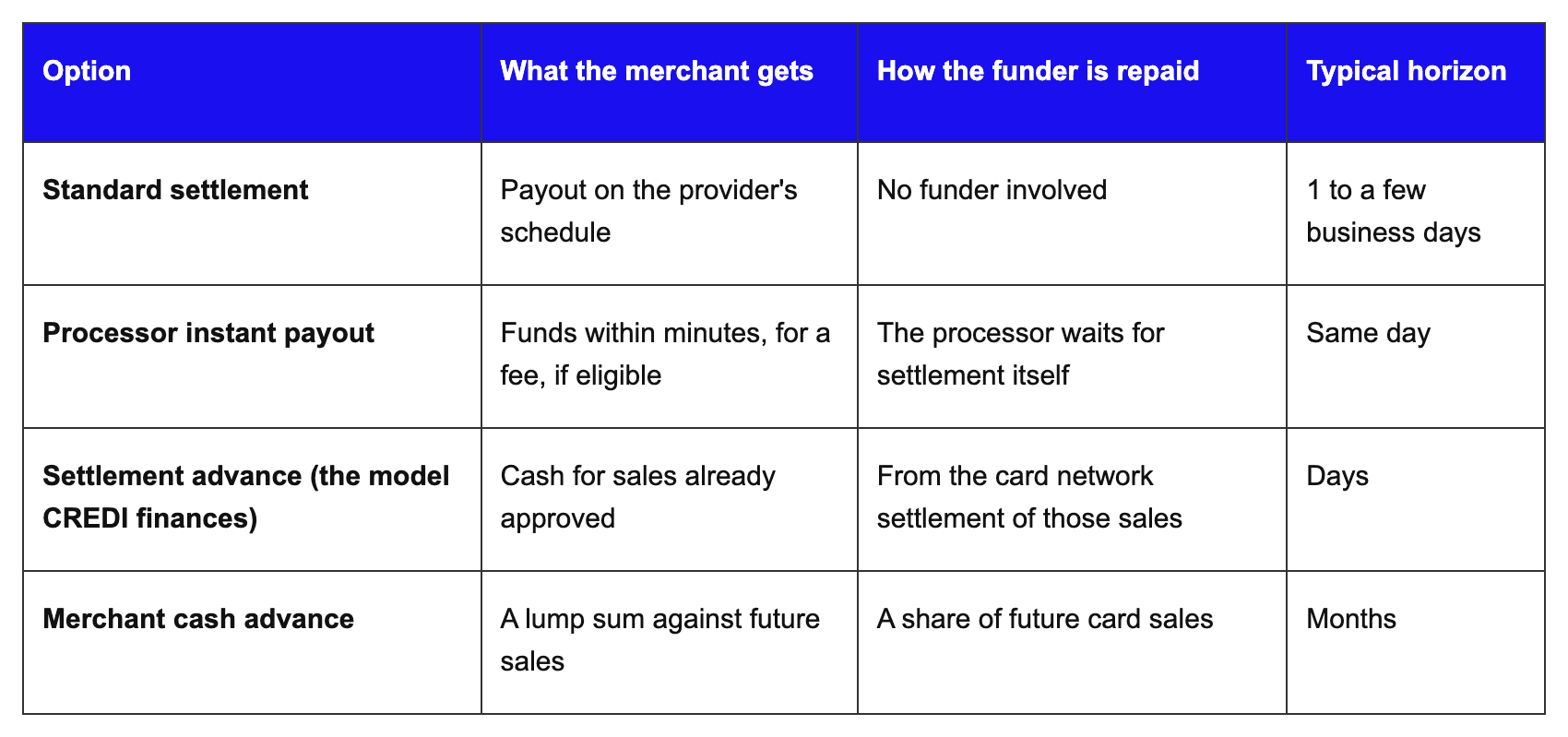
A settlement advance funds sales that already happened and are already moving through the card system. Its term is days, and each advance can be matched to a specific settlement. A merchant cash advance funds future sales over months. CREDI focuses on the first model because each advance is short and traceable from sale to repayment.
How CREDI Connects the Whole Chain
CREDI is infrastructure for private credit: the layer that connects liquidity providers' capital to real-world receivables. Its first fully integrated vertical is the one this article has followed, where that capital finances the settlement cycle so merchants can be paid before card settlement arrives. CREDI works with specialist partners across payments, vault infrastructure and data, and the merchant opts into early settlement through the provider it already uses. The card network's settlement then repays the vault.
Here is the flow, step by step:
- Liquidity providers (LPs), the investors who supply capital, deposit stablecoin capital (USDC, a digital dollar token) into a vault, for example the CREDI USDC Vault on Turtle.
- A merchant opts into early settlement through its payment provider.
- The merchant receives payment for its approved card sales right away, and vault capital covers the wait.
- The card network settles on its normal schedule, and that settlement repays the vault.
- The repaid capital funds the next round of approved sales.
For the bigger picture of how this credit is recorded and tracked on a blockchain, see on-chain private credit explained, and for the asset class itself, what is private credit.
This model carries risk. Returns depend on the partners, the merchants' dispute rates and the settlement chain working as expected, and LP capital can lose value.
Frequently Asked Questions
Is merchant settlement the same as the Visa and Mastercard settlement?
No. The Visa and Mastercard interchange fee case is a legal class-action settlement over swipe fees. Merchant settlement in the payments sense is the routine process that pays out card sales to a business. If you are looking for a class-action claim, use the official court-authorized claims website.
Is a payment facilitator the same as a merchant acquirer?
No. The acquirer is the licensed network member that signs merchants and takes responsibility for their transactions. A payment facilitator contracts with an acquirer and signs up smaller "sponsored" merchants under that relationship. The facilitator receives settlement from the acquirer and must then pay its merchants.
Why was my first payout held longer than later ones?
New accounts carry more unknowns, so providers wait longer before the first payout. Stripe, for example, says a first payout typically completes within 7-14 days, depending on industry, country and risk level. After that, accounts usually move to the standard schedule unless risk criteria keep them on slower timing.
How long does a merchant have to settle a transaction?
Card network rules set a maximum window that starts at authorization, and the acquirer applies it through the merchant agreement. Under the Visa Core Rules (April 2026), an acquirer must process a completed card-present transaction within 5 calendar days of authorization, a cardholder-initiated online or phone transaction within 10, and some hotel, car rental and cruise transactions authorized for an estimated amount within 30. Most merchants submit their sales in a daily batch, well inside those limits.
Do weekends and holidays delay card settlement?
Usually yes. Many providers count settlement in business days, so a sale on Friday evening can take four calendar days or more to arrive. Holidays add more days. Check whether your agreement counts business days or calendar days.
Who provides the money for early settlement?
Liquidity providers. They deposit stablecoin capital into a vault, that capital covers the settlement gap, and card settlement repays it. LPs are exposed to the risks described above, including disputes and the performance of the payment chain.
Can a settlement advance be reversed if a customer disputes the payment?
It depends on the contracts behind the early settlement offer. The dispute itself still happens: the issuer can reverse the sale, and the money has to come from somewhere. Read who bears dispute losses before opting into any early settlement offer.
See How CREDI's Private Credit Infrastructure Works
Every card sale opens a short gap between approval and cash. Merchants have always carried it. Early settlement can now close it, and CREDI provides the infrastructure that connects that gap to the capital that funds it. See how CREDI's private credit infrastructure works.
This article is for information only and is not financial, investment or legal advice.


