
What Is On-Chain Private Credit? How It Works and Who Pays
By Credi Team

TL;DR
- On-chain private credit is lending to real businesses, such as advances against invoices or card payments, where the capital, repayments and records move on a blockchain.
- The blockchain records and settles transactions; underwriting decisions, legal claims and collections stay with people off-chain.
- The return comes from a business paying a fee to get its money early. Credit yield always traces back to a named payer of that fee.
- Most tokenized credit today uses the chain as a shared record: RWA.xyz tracks about $37 billion of "represented" credit against about $8 billion "distributed" (October 2026).
- The strongest pools are easy to explain: a short-term asset, a known payer and a clear structure that protects investor capital.
What Is On-Chain Private Credit?
On-chain private credit is private lending to real businesses in which investors fund loans or receivables with stablecoins, and the deposits, repayments and ownership records sit on a public blockchain. The credit decision stays off-chain with human underwriters. The blockchain handles settlement and record keeping, so investors can follow the money as it moves.
Private credit means loans made by non-bank lenders and negotiated directly with the borrower. A stablecoin is a token designed to hold a steady value against a currency, usually the US dollar (USDC is a common one). A liquidity provider, or LP, is the person or fund that supplies the capital.
The flow is simple. An LP deposits stablecoins into a vault, a smart contract that pools capital under fixed rules, and that capital funds short-term financing for real businesses. Repayments flow back to the vault.
You will also see "tokenized private credit" and "private credit tokenization." Both describe the same idea from the asset side: a loan or pool of loans represented as a token.
What Is Actually Being Financed?
Most on-chain private credit finances short gaps in a business's cash flow, where money is already owed and due to arrive soon. The two types that moved on-chain early share one trait: a short life and a known source of repayment.
Invoice finance. A supplier delivers goods and sends an invoice with payment due in 30 to 90 days. A lender advances part of that invoice now and is repaid when the customer pays. The main credit question is whether the customer pays.
Card payment receivables. A shopper pays by card and the sale is approved in seconds, and the merchant is usually paid days later, once the payment clears through the card network and the acquirer (the bank or payment company that processes card payments for the merchant). A lender can fund that wait. We explain the full chain in why merchants wait days to get paid.
The receivable in this second case is a sale that has already happened. That changes the risk profile, and some risk remains. Refunds, chargebacks (a customer disputing a card payment) and the failure of a partner in the chain can all reduce what comes back.
Now what? When you look at any pool, ask for one sentence that names the asset: "We fund X, owed by Y, repaid when Z happens."
Who Owes the Money?
In on-chain private credit, the borrower is a real company with a legal obligation to repay, and repayment usually comes from that company's own customers or its payment network. The token you hold is a claim on that chain of obligations. Its value depends on the weakest link.
A typical receivables deal has four parties. The LP provides capital, and the originator, often a payment or financing partner, finds and checks the business that needs cash.
The business receives the advance. The end payer, such as an invoice customer or the card network settlement, sends the money that closes the loan.
Most of the risk sits in the middle two links. If the originator overstates what it is financing, or another creditor has a prior claim, the cash can stop short of the vault. A public ledger shows you when a payment is missing.
What Does the Blockchain Do, and What Does It Not Do?
The blockchain records and settles. It moves capital at any hour and keeps a shared record of every deposit and repayment. Judging whether a business will pay an invoice in 40 days is the underwriter's job.
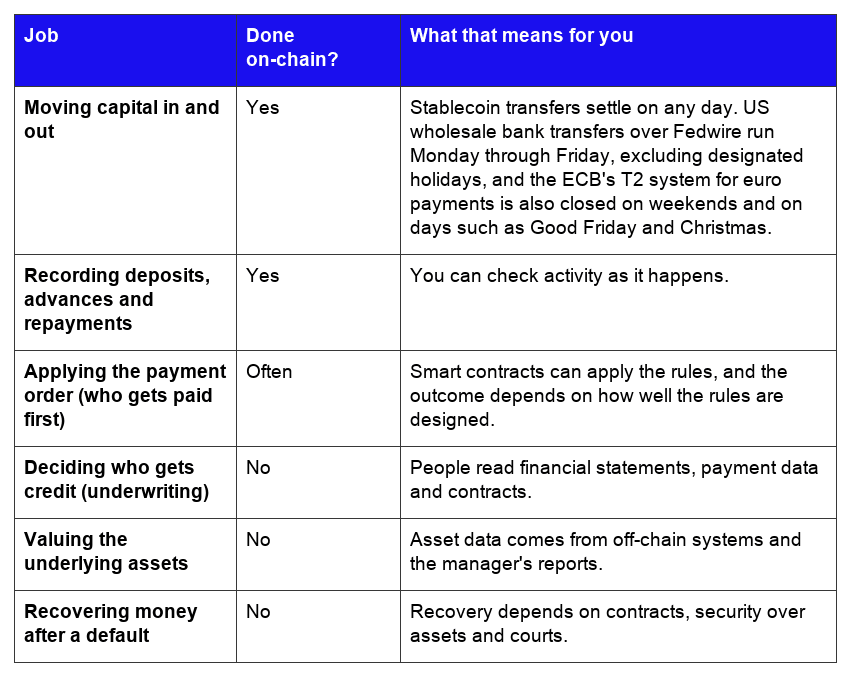
As one fintech publication put it in September 2026, "A faster ledger doesn't change how a loan was underwritten in the first place" (The Financial Revolutionist). That is the correct frame. The ledger improves how you see a credit book; the quality of the book comes from underwriting.
Most tokenized credit today works as a shared record
RWA.xyz, the main public data source for tokenized assets, splits them into two groups. "Distributed" assets can move to wallets outside the issuing platform. "Represented" assets cannot, and for them "the blockchain serves as a recordkeeping and reconciliation layer for institutional participants."
On October 6, 2026, the RWA.xyz tokenized credit dashboard showed about $37.2 billion of represented credit and about $8.0 billion distributed. In other words, most credit "on-chain" today uses the ledger as a shared back office. That is useful for record keeping. A token you can sell to anyone at any time is a separate product.
A distributed token can move between wallets, and selling it still needs a buyer. Some represented assets can also be transferred within a platform.
Central banks are now building for that back office. On September 21, 2026, the Eurosystem launched Pontes, a service that settles wholesale transactions in tokenized assets in central bank money, with full implementation expected by 2028.
Now what? When a product calls itself on-chain, ask which jobs in the table above actually run on-chain, and whether your position can move or be sold.
Where Does the Return Come From?
The return in on-chain private credit comes from a business paying a fee to receive its money early, minus the platform's costs and any losses. If you trace the payment backwards and it stops at a real company paying for financing, you are looking at credit.
Here is a simple worked example. All numbers are illustrative.
- A merchant makes $10,000 in card sales today. The card network will settle the money in about five days.
- A payment partner offers the merchant its money today, funded by LP capital, and charges a fee of $20 for the five-day wait.
- When the card payment settles, the $10,000 flows back. The fee, minus the partner's and platform's share, is the return on that capital.
The yield is a price paid by someone who needs money sooner. We explain the difference between that and emissions-based yield in where DeFi yield comes from, and Credi has written about the first generation of DeFi credit in The Illusion of Yield.
Now what? Follow the money back from any rate you are shown. In private credit, it ends at a real business paying for financing.
How Does the Capital Stack Work?
Private credit pools protect investor capital through structure. Capital is split into layers called tranches: senior capital is repaid first, and junior capital, also called first-loss capital, sits underneath it as a cushion. When the originator or borrower provides that junior layer, the business that knows the assets best has its own money at stake ahead of the investor.
What Are the Risks?
The main risks of on-chain private credit are the same as in any private credit, plus a few that come from the technology. Putting a loan on a blockchain makes some risks easier to see.
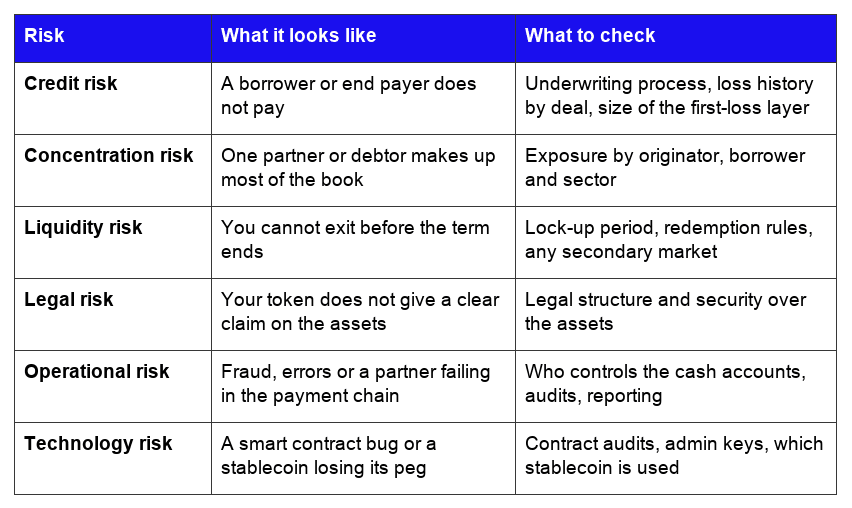
Only the last row is new to credit investors. On-chain, the main change is visibility: a missed repayment can show up within days.
How Big Is the Market?
On-chain private credit is still small next to traditional private credit and is one of the larger parts of the tokenized asset market. Numbers vary by how each source counts, so read them as rough directions.
- Tokenized assets overall: InvestaX's Q1 2026 market report, using RWA.xyz data, puts tokenized real-world assets excluding stablecoins at about $29 billion, compared with roughly $7.9 billion in 2024.
- Credit got there fast: Chainalysis found in April 2026 that asset-backed credit took 6.1 months to reach $1 billion in on-chain value, compared with 36.2 months for commodities.
- Forecasts are large: BCG projected in April 2026 that tokenized real-world assets could reach $14 trillion by 2030. That projection covers all tokenized assets.
RWA tokenization, the process of turning a claim on a real asset into a token, is the wider trend. Private credit is one of the asset classes inside it, next to tokenized Treasury funds, commodities and real estate.
Where Does Credi Fit?
Credi is infrastructure for private credit: an on-chain layer that gives liquidity providers (LPs) access to high-quality private credit through vaults. Each vault feeds a credit vertical that is fully integrated with the platform, with the structure, rules and reporting built in. The first is on-chain receivables: payment partners originate short-term card and invoice receivables and pay merchants sooner than standard card settlement allows, the vault finances the partners, and the vault is repaid when the settlement arrives.
Credi does not lend to merchants directly. A payment or receivables partner always sits between Credi and the merchant.
Credi publishes its approach to reporting in why private credit needs a different kind of transparency.
Frequently Asked Questions
Is on-chain private credit the same as DeFi lending?
No. DeFi lending usually lets you borrow crypto against more crypto collateral, and a smart contract sells that collateral if its value drops. On-chain private credit lends to real businesses against invoices or receivables, backed by off-chain underwriting and legal recourse.
Is tokenized private credit the same as on-chain private credit?
Mostly, yes. "Tokenized private credit" describes the loan or pool turned into a token, while "on-chain private credit" covers the whole process, including how capital moves and repayments are recorded. Check whether the token can be transferred or only records ownership.
Can I sell my position before the term ends?
It depends on the product. Some pools have fixed terms with no early exit, some allow redemptions at set times, and some rely on a secondary market or an over-the-counter buyer. Read the exit terms before depositing, and assume liquidity may be limited in a stressed market.
See How Credi's Private Credit Infrastructure Works
On-chain private credit is an old kind of lending with a new settlement and record-keeping layer. That layer moves money faster and shows you what happened. Strong underwriting and a solid structure still decide the outcome.
If you want to see how a receivables-backed model works in practice, with payment partners and merchants, see how Credi's private credit infrastructure works.
This article is for information only and is not financial, investment or legal advice.


