

TL;DR
- A credit card payment happens in two speeds. Authorization (the card bank saying "yes") takes seconds, while the money itself moves later through clearing and settlement.
- Four parties do the work: the issuer (the cardholder's bank), the acquirer (the merchant's bank), the card network (Visa, Mastercard) and the merchant's payment provider. Each one takes a small cut, mostly through interchange, a fee the acquirer pays the issuer on every sale.
- In the US, people made 67.1 billion credit card payments worth $6.51 trillion in 2024. Every one of them ran through the same three steps.
- A card payment holds two waits: the merchant waits days for its money, and the issuer waits weeks for the cardholder to pay the bill. A chargeback (a disputed sale pulled back) can still reverse the sale after both.
- The merchant's wait is a short, known receivable. CREDI finances the wait between a card swipe and its settlement, connecting onchain capital to those real-world receivables.
Card payments feel like one event: tap, beep, done. Underneath, the Federal Reserve counted 67.1 billion US credit card payments worth $6.51 trillion in 2024, up from 51.0 billion in 2021, and in its July 2026 release noted that credit card payments grew faster than debit for the first time in almost a decade. That works out to an average ticket of about $97 (our calculation from the Fed's figures).
Each of those payments is a promise first and money later. The approval at the counter only tells the merchant the cardholder's bank will pay. The money arrives after a chain of batch files, net transfers between banks and payout schedules, and the cardholder repays their own bank weeks after that.
This guide follows one swipe from the terminal to the merchant's bank account and on to the cardholder's monthly bill. Along the way it shows who each party is, what they get paid, and where the days of waiting come from, because those days are exactly what CREDI finances.
How do credit card payments work, step by step?
Credit card payments work in three stages. Authorization: the card network asks the cardholder's bank (the issuer) to approve the sale, which takes seconds. Clearing: the merchant's bank (the acquirer) sends the final sale details through the network. Settlement: money moves from the issuer to the acquirer, which then pays the merchant, usually one or more business days later.
After settlement there is a fourth step that most guides skip: the cardholder pays the issuer back when the monthly bill comes due. So one swipe sets off two repayments, one between banks and one between the cardholder and their bank.
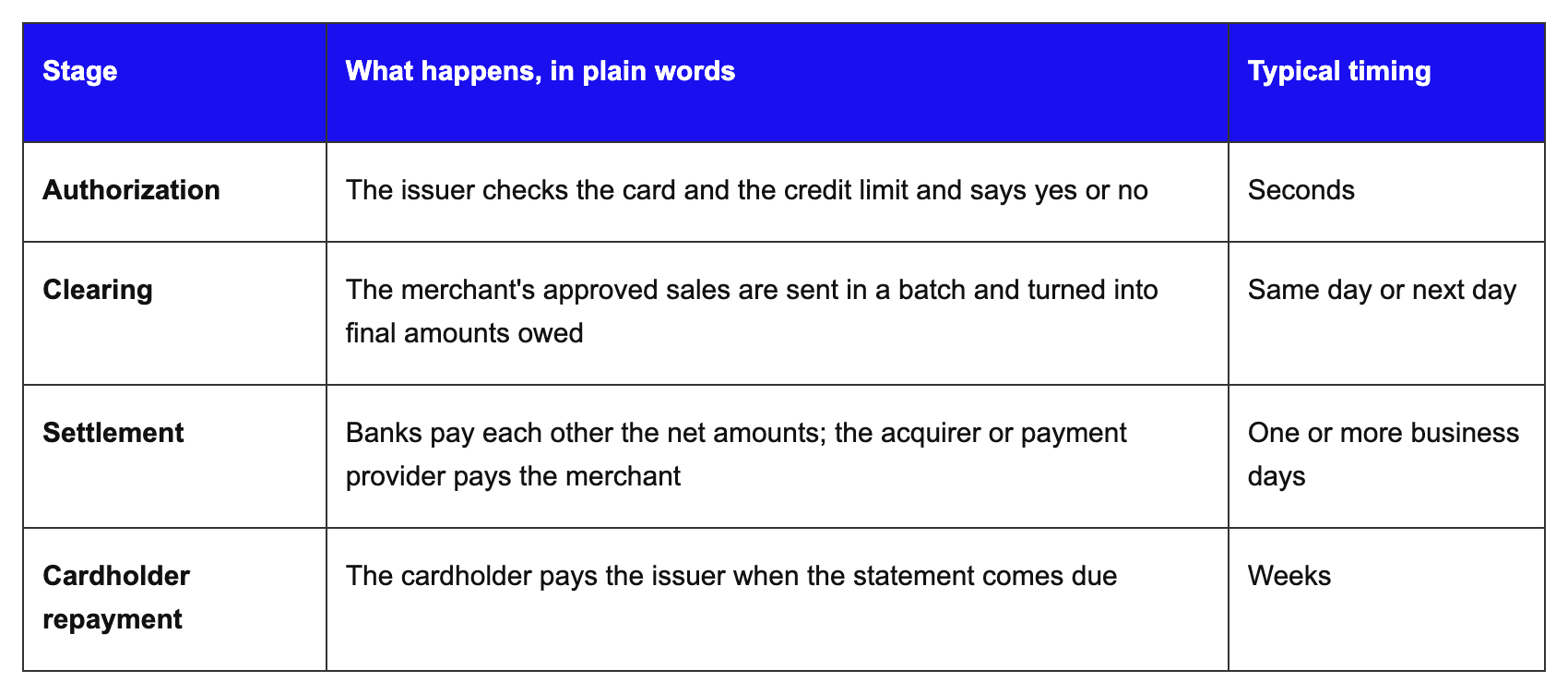
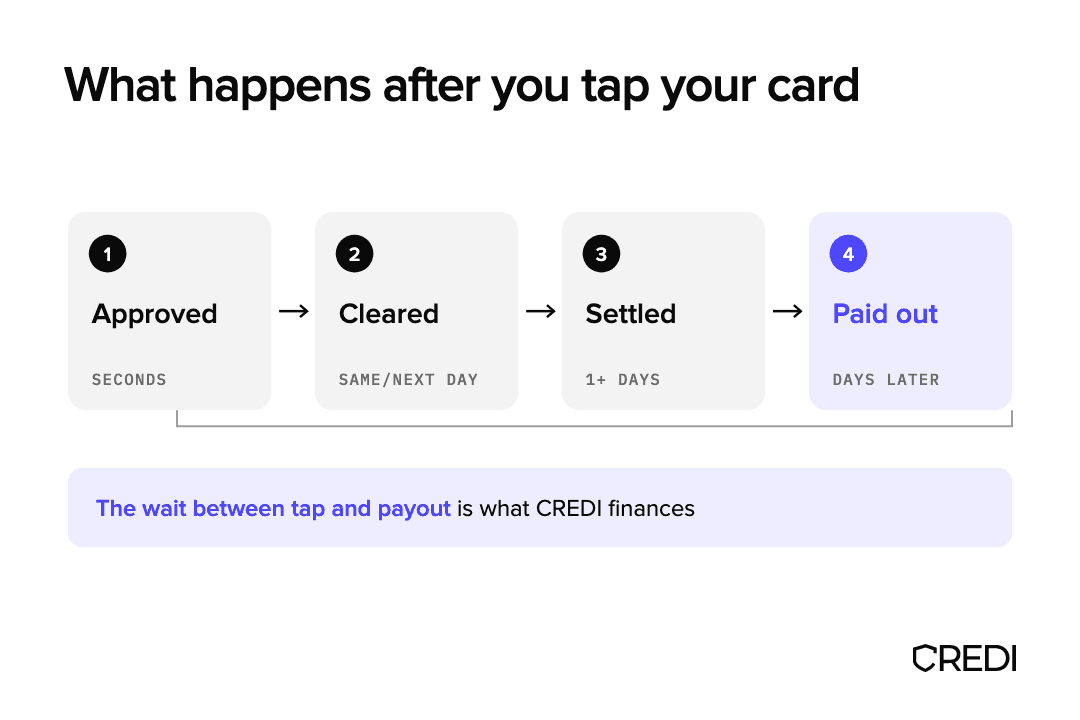
The gap between the first row and the third is the stretch where a merchant has made a sale but holds no cash. That gap is the receivable CREDI finances.
Who are the issuer, the acquirer and the card network?
The issuer is the bank that gave the customer the card, the acquirer is the bank that lets the merchant accept cards, and the card network is the system that connects them. Visa's rules define an acquirer as a member that "signs a Merchant or Payment Facilitator" and enters transactions into the network, and an issuer as a member that contracts with a cardholder "for the issuance" of cards (Visa Core Rules, October 2026 edition).
The "issuer vs acquirer" question trips up most newcomers, so here is the short version: the issuer stands behind the shopper and the acquirer stands behind the store. Many small merchants never deal with an acquirer directly. They sign up with a payment service provider (PSP), a company such as a payment facilitator or processor that handles card acceptance and passes the money through.
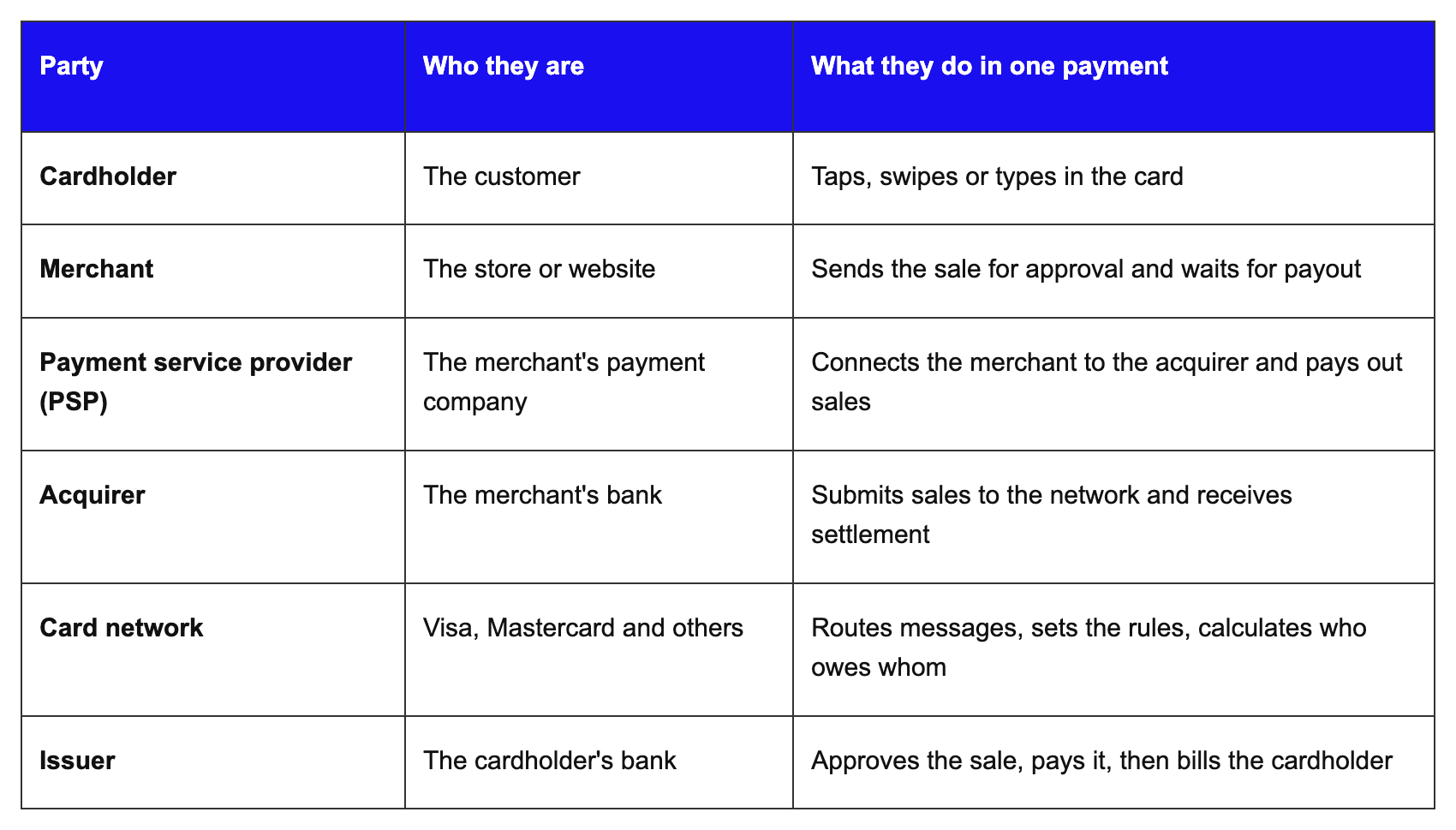
CREDI works on the merchant side of this table, through payment partners that sit between merchants and acquirers.
Authorization is a promise to pay, made in seconds
Authorization is the issuer's real-time "yes" to a sale. When the card is tapped or typed in, the terminal or checkout page sends a request to the acquirer, the network routes it to the issuer, and the issuer checks that the card is valid, the account is open, the credit limit has room and the sale does not look like fraud. The answer travels back the same way before the receipt prints.
"A process where an Issuer, a VisaNet Processor, Visa Scheme Processor, or Stand-In Processing approves a Transaction." Visa Core Rules, definition of Authorization, October 2026
An approval moves no money. The issuer places a hold on the cardholder's available credit, which is why a purchase shows up as "pending" first. The merchant now has a promise from the issuer and nothing in its bank account.
That promise is the starting point of a card receivable: an amount the card system owes the merchant for a sale already made. Financing a card receivable, the way CREDI does, starts here and ends at settlement.
Clearing turns the day's approvals into final amounts
Clearing is the step where approved sales become final, billable records. At the end of the day (or at a cutoff the payment provider sets), the merchant's terminal or gateway sends its approved sales as a batch. The acquirer passes them into the network, which checks each record, applies the right fees and works out how much each bank owes the others.
Visa describes clearing as "a processing service for the validation and valuation" of the records exchanged between Visa and its members (Visa Core Rules, October 2026). In plain words: checking that each sale is real and putting a final number on it. A tip added after approval, or a hotel bill that ends up larger than the hold, gets its final amount here.
A few things decide how fast clearing happens:
- Batch cutoff: a sale made after the cutoff waits for the next cycle.
- Business days: network and bank cycles run on business days, so weekend sales wait.
- Merchant setup: some providers close batches automatically; others wait for the merchant to do it.
Once a sale has cleared, its amount is known and the bank that owes it is known. For anyone financing receivables, including CREDI, cleared card sales are the clearest kind of receivable: a fixed amount, owed by a regulated bank, due within days.
Settlement is when the money actually moves
Settlement is the transfer of money between banks for the amounts worked out in clearing. Card networks settle on a net basis: each bank sends or receives one total for the day, covering all of its sales. Visa's rules define the settlement amount as "the daily net amounts" resulting from clearing.
"The reporting and funds transfer of Settlement Amounts owed by one Member to another, or to Visa, as a result of Clearing." Visa Core Rules, definition of Settlement, October 2026
Settlement between banks still leaves one hop: the acquirer or payment provider paying the merchant. That payout runs on its own schedule. Stripe, for example, lists a settlement timing of 2 business days for US accounts, and first payouts for new accounts can take longer. We cover the reasons for the delay, from batch cutoffs to risk holds, in why merchants wait days to get paid.
This is where the CREDI cycle closes. CREDI finances the wait between a card swipe and its settlement, and the financing is repaid when the card payment settles.
How this connects to CREDI
Every step so far takes seconds, apart from the last one. Between the approval and the settlement, the merchant has made the sale and is still waiting for the money. That waiting period is a receivable: a known amount, owed through the card system, due within days. CREDI finances that wait. Its vaults connect onchain capital to card receivables through payment partners, and each financing is repaid when the card payment settles.
Keep reading: next, a $100 sale is split to show who keeps what, then the merchant's wait is set next to the cardholder's, and the guide ends with chargebacks, the main way a settled sale can come back. For why the wait exists in the first place, see why merchants wait days to get paid.
See how CREDI finances card settlement →
Who gets paid what on a $100 card sale?
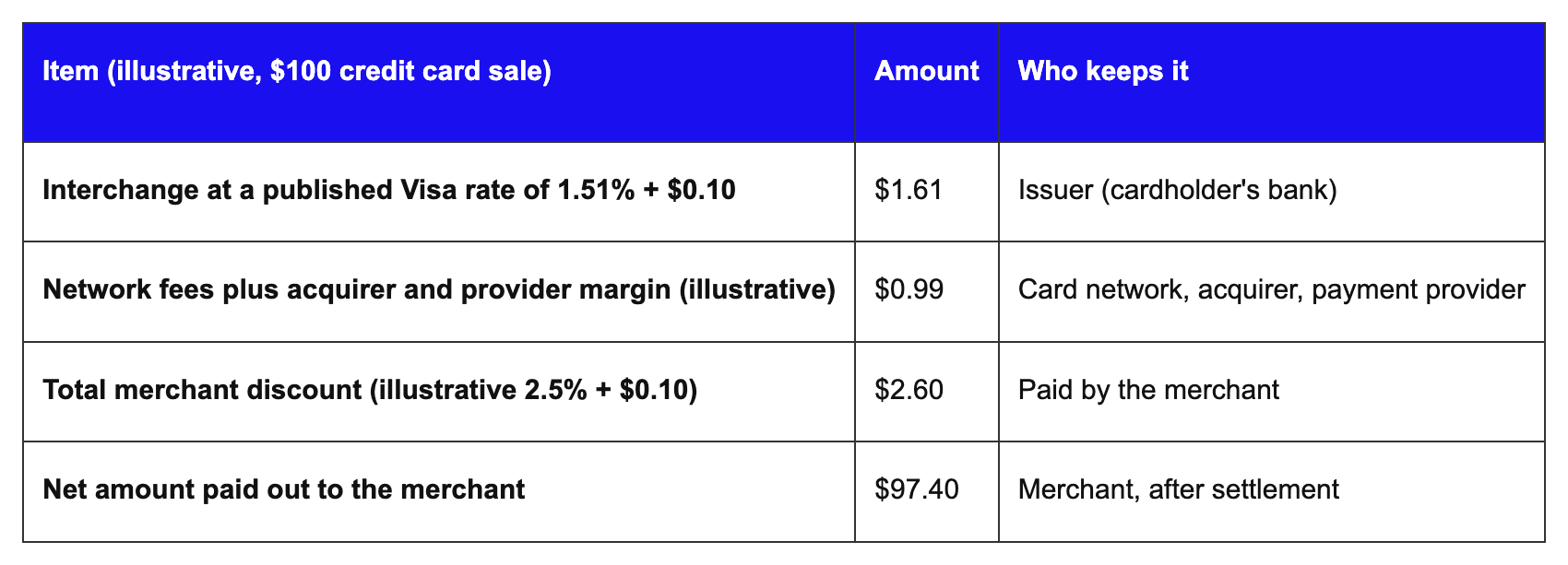
The merchant receives the sale amount minus its card processing fees, and a large share of that fee goes to the cardholder's bank as interchange. Interchange is a per-sale fee, taken from the card network's published schedule, that the acquirer pays the issuer. Visa calls these fees "transfer fees between acquiring banks and issuing banks" and states that "merchants do not pay interchange reimbursement fees" directly; merchants pay a bundled "merchant discount" to their own provider, which covers interchange and everything else.
Visa's published US rates for card-present retail credit sales, effective October 24, 2026, range from 1.43% + $0.10 to 2.30% + $0.10 depending on the card product (Visa USA Interchange Reimbursement Fees). Here is how a $100 sale could split, using one of those published rates and illustrative figures for the rest.
Debit cards follow the same steps at a lower price: for debit cards from large US banks, interchange is capped by the Federal Reserve's Regulation II, and Visa lists 0.05% + $0.21 for those regulated card-present debit sales.
The last row is the number that matters for receivables finance. When CREDI finances card receivables, the amount repaid at settlement is the net payout, after fees.
A card payment contains two waits, and they last different lengths
Every credit card sale creates two waits at once. The first runs from the issuer to the cardholder: the issuer pays at settlement, a day or two after the swipe, and the cardholder repays weeks later. The second runs the other way along the chain: the merchant hands over the goods at the counter and waits days for the payout.
The cardholder's wait is built into US law. Card issuers must deliver statements "at least 21 days prior to the payment due date" (12 CFR 1026.5). The CFPB defines the grace period as "the period between the end of a billing cycle and the date your payment is due"; pay the full balance and no interest is charged. Carry a balance and the cost climbs: the average rate on accounts assessed interest was 22.36% in the third quarter of 2026.
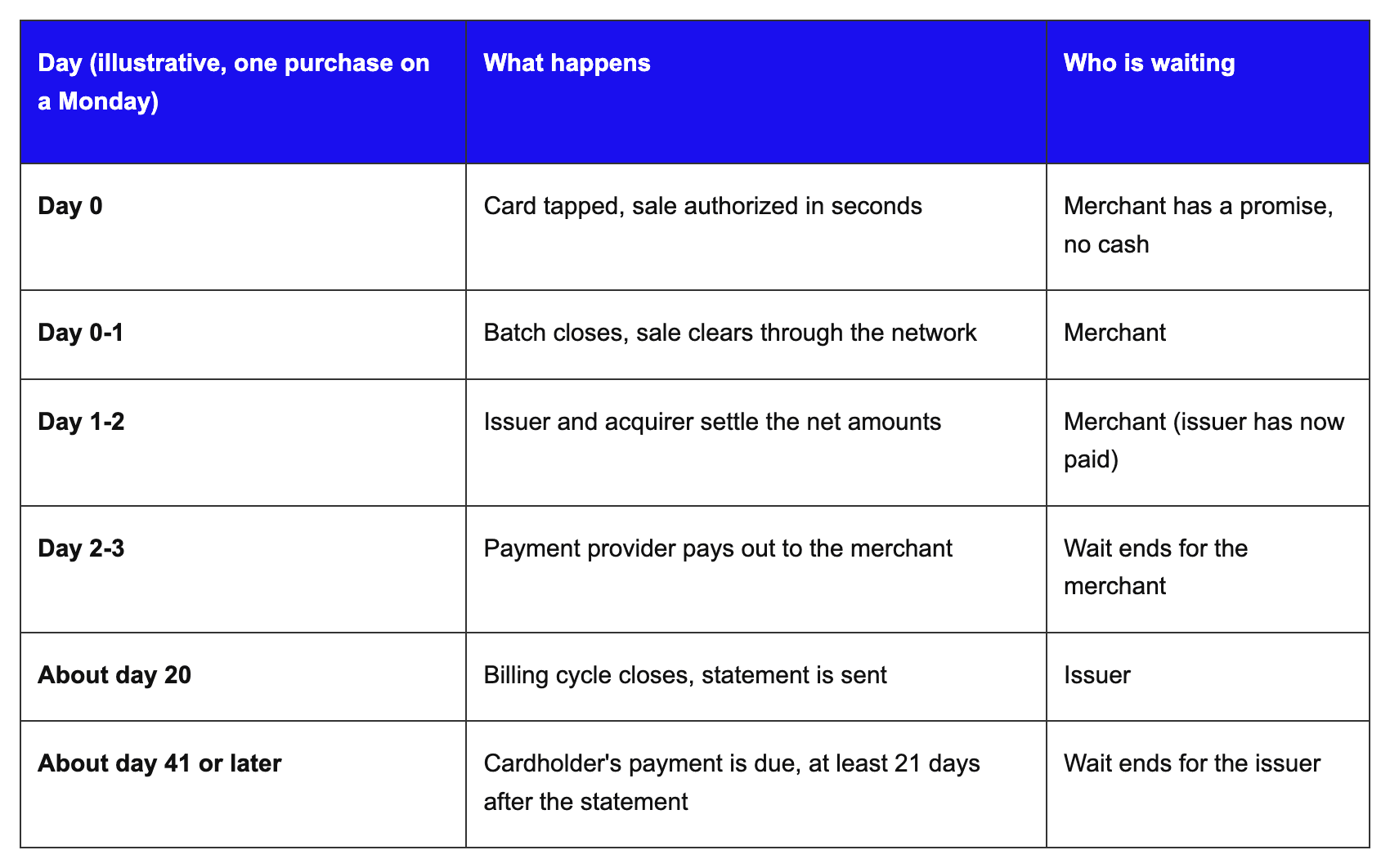
The issuer's wait is the business of credit cards, funded by banks and paid for with interest and fees. The merchant's wait is shorter, sits with the business that made the sale, and grows with every sale the business makes. CREDI finances the merchant-side wait.
Chargebacks can reverse a payment after it settles
A chargeback is a sale that the cardholder's bank pulls back after the cardholder disputes it, for example because of fraud or goods that never arrived. Visa defines a dispute as "a Transaction that an Issuer returns to an Acquirer." The money flows back through the same chain, and the merchant's payout shrinks by that amount.
The time limits are long compared with settlement. US cardholders can send a written billing error notice "within 60 calendar days after the charge appeared on your statement" (CFPB). Under Visa's rules, the time limit for several fraud dispute conditions is 120 calendar days from the processing date.
What raises chargeback risk for a merchant:
- Card-not-present sales (online and phone), where the card's chip cannot be read
- Delayed delivery, such as travel, events or preorders, where "not received" claims show up late
- Unclear billing names that cardholders do not recognize on their statement
For anyone financing card receivables, chargebacks are the main way a "settled" sale can come back. Disputes are one of the core risks of financing card payments, CREDI included, alongside the reliability of the payment partners in the chain.
Where CREDI fits in the card payment chain
CREDI finances the wait between a card swipe and its settlement. It is infrastructure for private credit: an onchain layer that connects onchain capital to real-world receivables, such as card payments that are approved and waiting to settle. If private credit is new to you, start with what private credit is and what onchain private credit is.
Here is how the pieces fit, in plain terms:
- Capital: liquidity providers deposit stablecoins (digital dollars such as USDC) into vaults built on Enzyme vault infrastructure on Ethereum.
- Receivables: CREDI works with payment service providers and payment partners that originate card receivables from merchants.
- Repayment: each financing position is repaid when the card payment settles, so durations are short, days to weeks.
- Checks: Accountable acts as the external attester of the book.
As of October 2026, CREDI had $16.37M funded to date with 0 realized losses to date. A clean record so far does not make it risk free. Chargebacks, a payment partner failing to pass funds through, operational or smart contract problems, and lock periods on capital can all cause delays or losses.
Frequently Asked Questions
What does "pending" mean on my credit card?
A pending charge is a sale the issuer has authorized but that has not yet cleared and settled. The issuer holds that amount against your available credit until the merchant's batch arrives. The final amount can differ from the pending one, for example after a tip is added at a restaurant or when a hotel or fuel pump hold is adjusted to the real total.
Do debit card payments follow the same steps?
Yes. Debit card payments go through the same authorization, clearing and settlement steps, run on the same networks. The difference is where the money comes from: a debit card draws on the cardholder's checking account, so there is no monthly bill or grace period. Interchange on debit cards from large US banks is capped by Regulation II.
Does paying my credit card bill affect the merchant?
No. By the time your bill is due, the merchant has normally been paid through settlement, and your payment goes to your issuer only. The merchant's exposure after settlement comes from disputes: if you file a chargeback, the amount can be pulled back from the merchant even weeks after the sale.
What is a card-not-present payment?
A card-not-present payment is one where the card is not physically at the terminal, such as an online checkout, an in-app purchase or a phone order. It follows the same authorization, clearing and settlement path, but the merchant cannot read the card's chip, so fraud checks lean on other data. Card-not-present sales often carry higher interchange rates in Visa's published schedule.
Does CREDI issue credit cards or lend to cardholders?
No. CREDI does not issue cards and does not touch the cardholder's bill. CREDI finances the wait between a card swipe and its settlement, which sits on the merchant side of the payment, and works through payment service providers. The cardholder's side of the payment, from authorization to the monthly statement, works the same way with or without CREDI.
See how CREDI connects capital to card payments
Every card payment you make starts a short, predictable wait between the swipe and the settlement, and that wait repeats billions of times a year. CREDI connects onchain capital to that wait through vaults, payment partners and external attestation, and the financing is repaid as payments settle. To see how the vaults work and what the risks are, visit CREDI →
This article is for information only and is not financial, investment or legal advice.


