

TL;DR
- Credit is an agreement where a lender gives you money, goods or services now and you repay later, usually with interest. Every credit product, from a credit card to a mortgage, follows that same deal.
- Interest is the price of time and risk: the longer the money is out and the less certain repayment looks, the more a lender charges. US credit card accounts that paid interest carried an average rate of 22.36% in Q3 2026.
- Credit comes in a few shapes: revolving or installment, secured or unsecured. Your credit score summarizes how you have handled those shapes so far, and lenders use it to decide whether to lend and at what price.
- Businesses run on credit too, mostly to cover the wait between making a sale and receiving the cash. When banks and public markets do not fund that wait, private credit often does.
- CREDI sits in that last group. It connects onchain capital to real-world receivables and finances the wait between a card swipe and its settlement, with terms measured in days to weeks.
Americans owed $19.1 trillion in household debt at the end of September 2026, according to the New York Fed, after a $334 billion rise in a single quarter. Credit card balances alone stood at $1.29 trillion. Credit touches almost everyone, yet most people only learn how it works once a bill arrives.
The mechanics are simple. A lender trusts you with money today, you promise to return it on a schedule, and interest pays the lender for waiting and for the chance you might not pay. The same logic runs a credit card, a car loan and the private credit funds that finance company invoices.
This guide starts with everyday borrowing and ends with business and private credit, including where CREDI fits.
How does credit work? Money now, repayment later
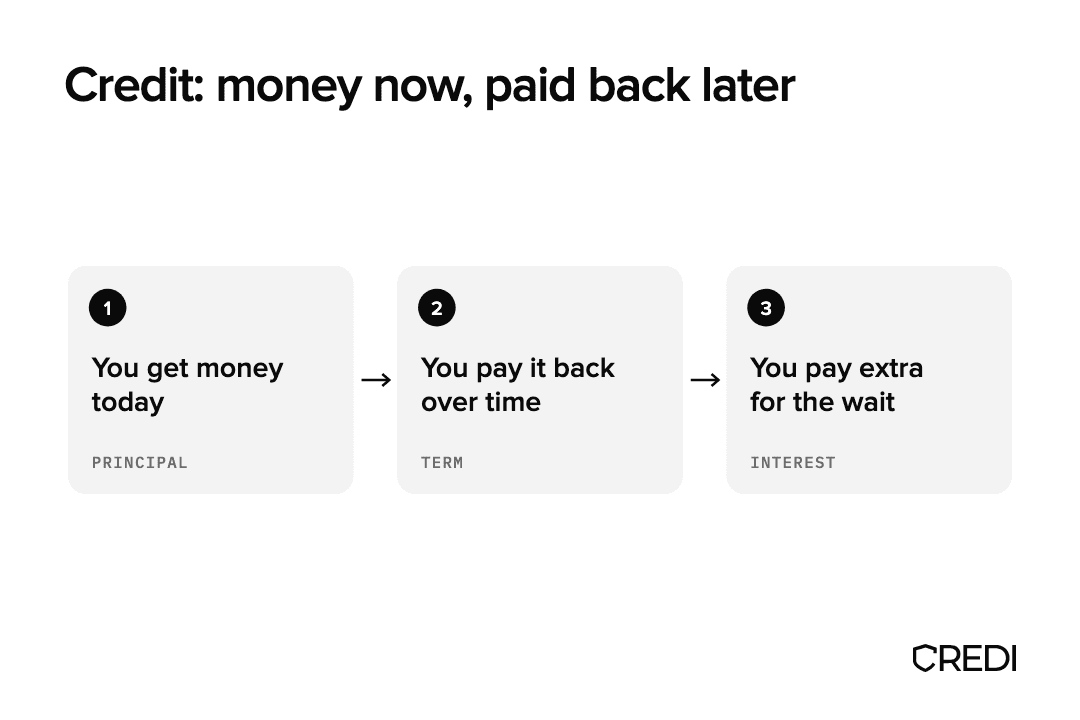
Credit works as an agreement: a lender gives a borrower money, goods or services today, and the borrower promises to repay the amount later, usually with interest added. The amount borrowed is the principal, the extra cost is interest, and the repayment schedule is the term.
Every credit deal has the same handful of parts. The table below defines each one and shows how the same part looks inside a CREDI vault, where the "lender" side is a group of depositors.
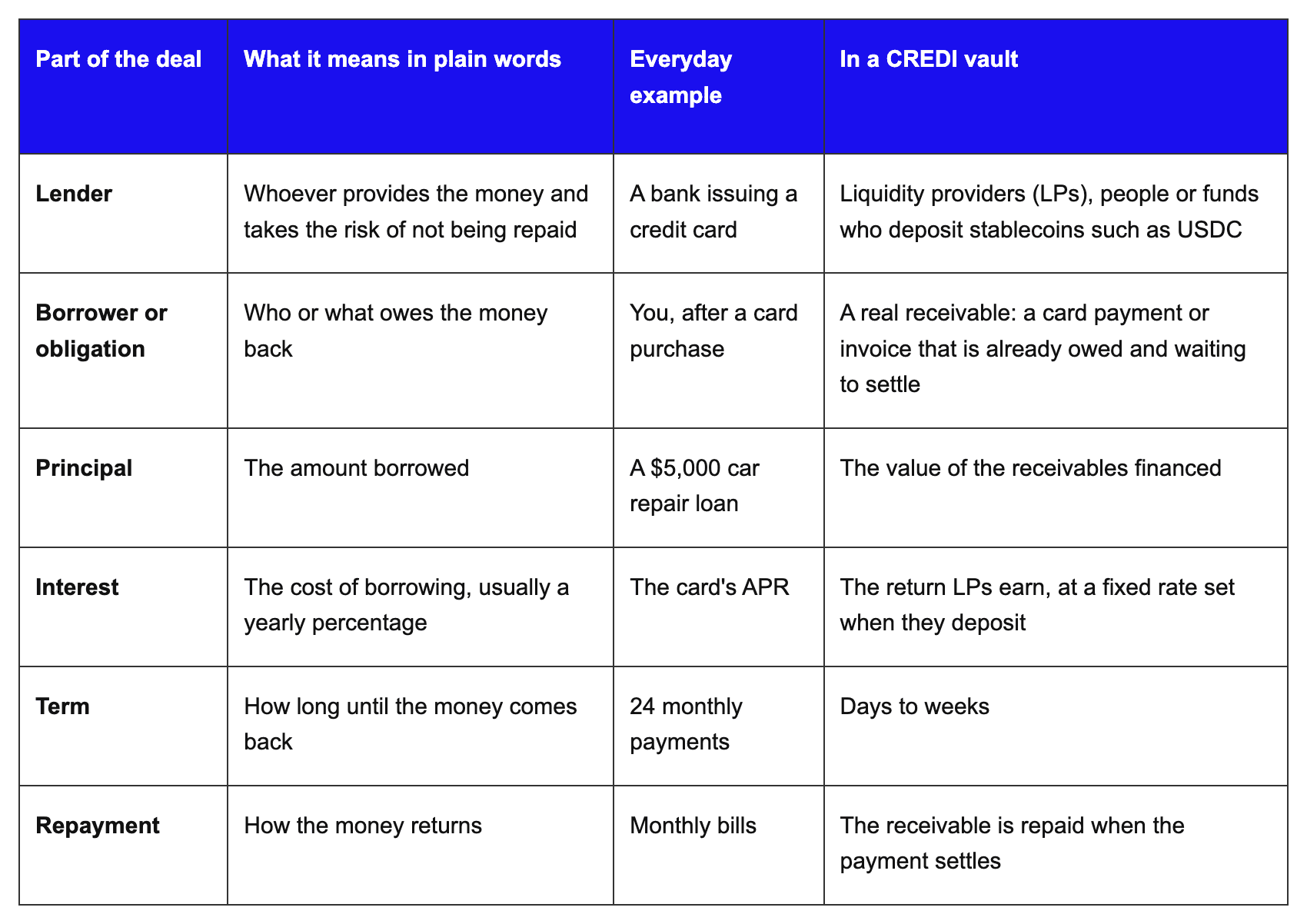
Two words in that table need a quick note. A stablecoin is a crypto token designed to hold a steady value, usually one US dollar. A receivable is money a business is owed for something it already sold, such as a card sale that has not yet landed in its bank account.
The roles never change, whatever the product.
Interest is the price of time and risk
Interest is what a borrower pays for using someone else's money, and lenders set it based on two things: how long the money will be out and how likely they are to get it back. It is usually quoted as an annual percentage rate (APR), the yearly cost of borrowing including most fees. A higher APR means the lender sees more risk, a longer wait, or both.
Credit cards show the effect clearly. Card balances are unsecured and can stay unpaid for years, so they carry some of the highest rates in consumer lending. The Federal Reserve reported an average rate of 22.36% in Q3 2026 on credit card accounts that were charged interest, against 21.19% across all card accounts (many people pay in full each month and pay no interest at all).
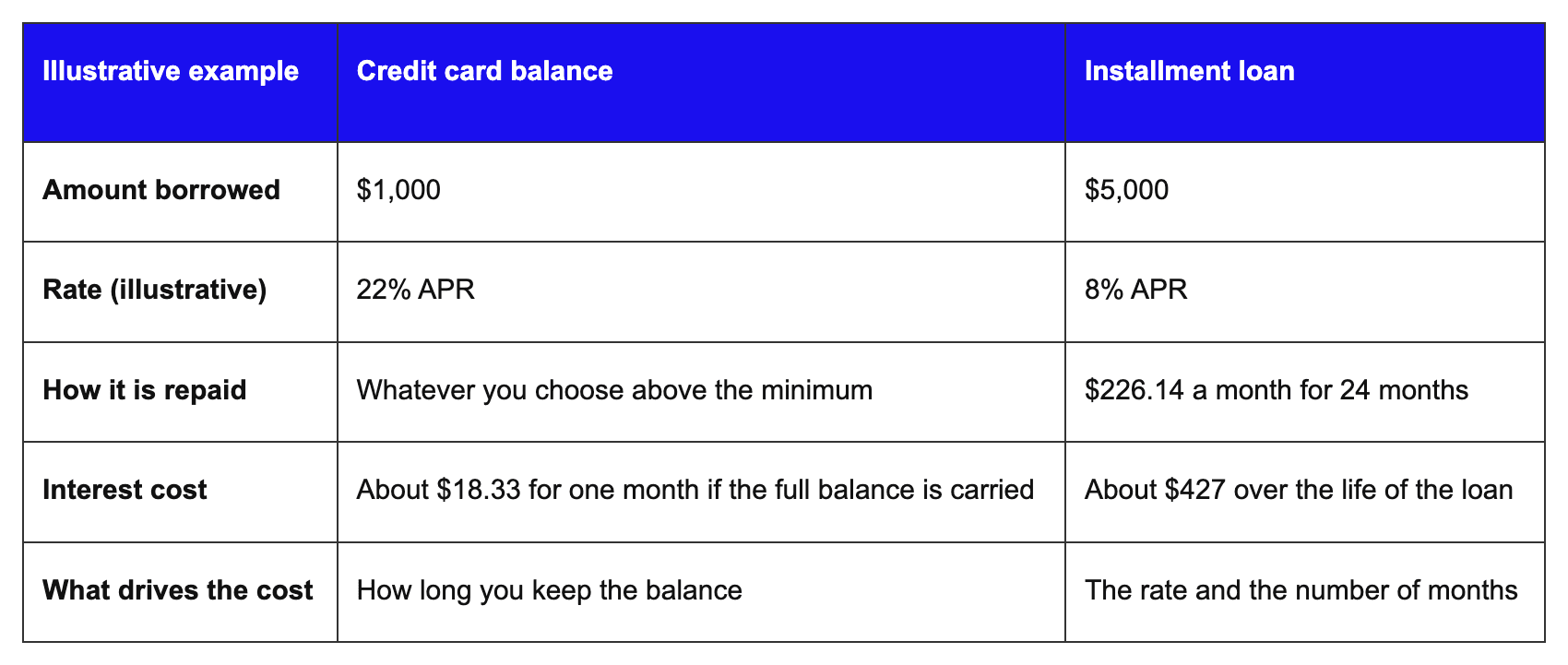
The numbers are illustrative and rounded. The pattern is what matters: time multiplies the cost of credit. It also multiplies risk. Credit repaid in days gives a lender less time for things to go wrong and more chances to check the borrower again, which is why CREDI focuses on receivables that settle in days to weeks.
Revolving and installment credit differ in how you borrow and repay
Revolving credit gives you a limit you can borrow from, repay and borrow from again, while installment credit gives you one lump sum that you repay in fixed payments until it is gone. A credit card is the classic revolving account. A mortgage, auto loan or student loan is installment credit. Both appear on your credit report and both affect your score.
With revolving credit, the balance and the payment move every month, and interest applies to what you carry past the due date. With installment credit, you know the payment and the end date on day one. A third shape, short-duration receivables financing, is how many businesses get paid faster.
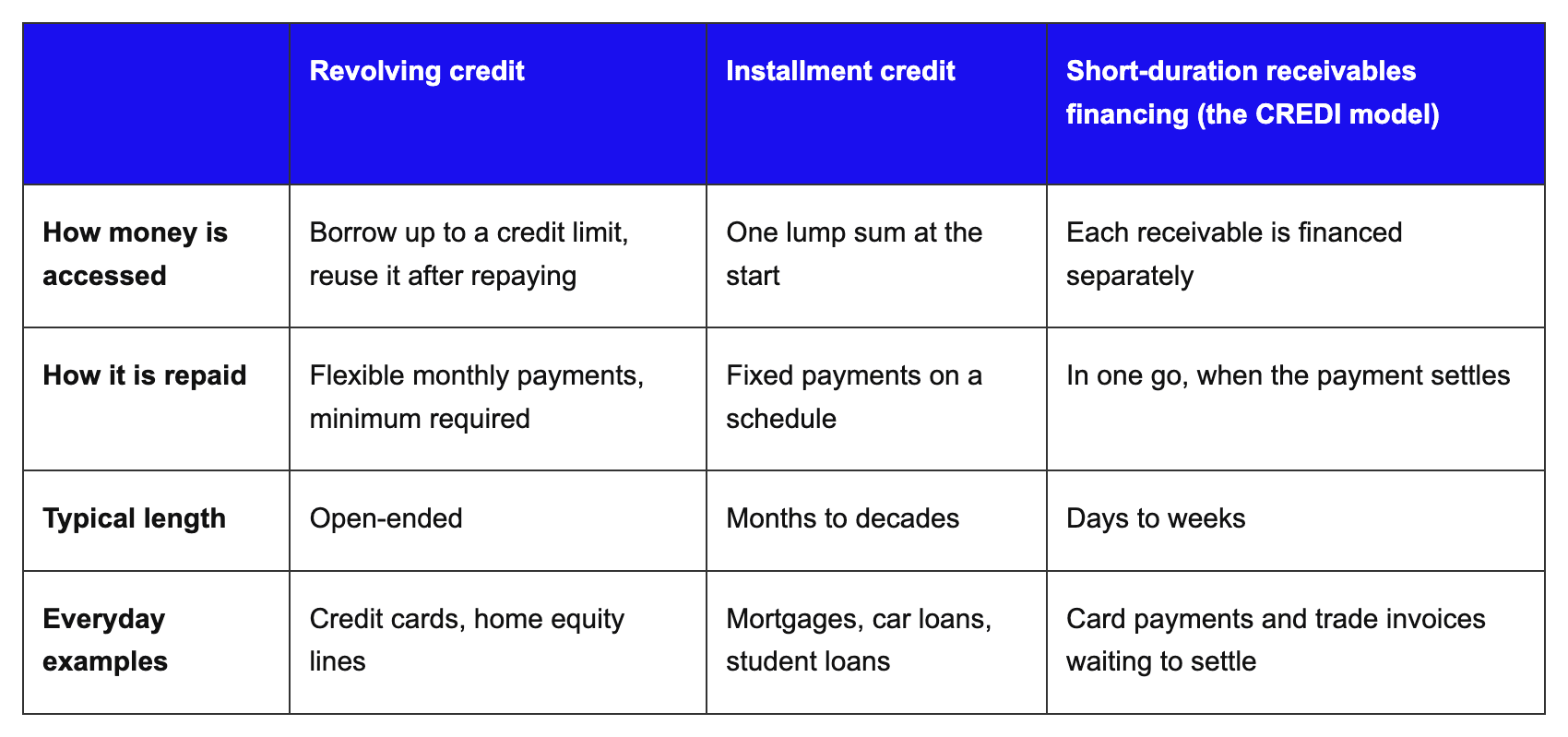
A credit limit is the maximum a lender lets you owe on a revolving account at one time. On a $2,000 limit, a $500 balance means you are using 25% of your available credit, a figure known as your utilization.
How this connects to CREDI
The last column of that table is where CREDI works. A card sale or a trade invoice is credit on a very short clock: the money is already owed, and it arrives within days to weeks. CREDI connects onchain capital to those receivables. Liquidity providers deposit USDC into a CREDI vault, the vault finances the wait between the sale and the settlement, and it is repaid when each payment settles, at a fixed rate set on the day of the deposit.
Keep reading: the next two sections cover what backs a loan (collateral) and how lenders judge a borrower (credit scores). CREDI asks the same two questions about every receivable it finances. After that, the guide moves from household credit to business credit and private credit, where CREDI sits. For the wider asset class, see what private credit is.
Secured credit is backed by something the lender can claim
Secured credit is backed by an asset, called collateral, that the lender can take if you stop paying, while unsecured credit is backed only by your promise and your credit history. A mortgage is secured by the house and an auto loan by the car. Most credit cards and many personal loans are unsecured.
Collateral changes the math for the lender. If a secured borrower defaults (stops paying as agreed), the lender can sell the asset and recover part or all of the money, so secured loans usually carry lower rates. An unsecured lender has fewer options after a default, so it charges more and leans harder on your credit score.
- Secured: mortgage (the home), auto loan (the car), secured credit card (a cash deposit you put down), home equity line (the home).
- Unsecured: most credit cards, personal loans, many student loans.
- Receivables: a separate case, where repayment comes from a payment that a customer already owes. In a CREDI vault, the source of repayment is the settlement of that specific card payment or invoice.
That last line is why receivables sit in their own category. The question a lender asks shifts from "will this person keep their job?" to "is this payment real, and will it settle?"
Your credit score is a summary of how you have repaid
A credit score is a three-digit number, usually between 300 and 850, that predicts how likely you are to repay on time, based on the information in your credit reports. The Consumer Financial Protection Bureau describes it as a prediction of your credit behavior, and lenders use it to decide whether to approve you, how much to lend and what rate to charge.
The score is built from your credit report, a record of your accounts, balances and payment history kept by the three nationwide credit bureaus (Equifax, Experian and TransUnion).
"Your credit history describes how you use money." Federal Trade Commission, Understanding Your Credit, November 2024
FICO, the most widely known scoring model, publishes the general weight of each category in its score. The weights below come from myFICO, which notes that their importance can vary from one person to another.
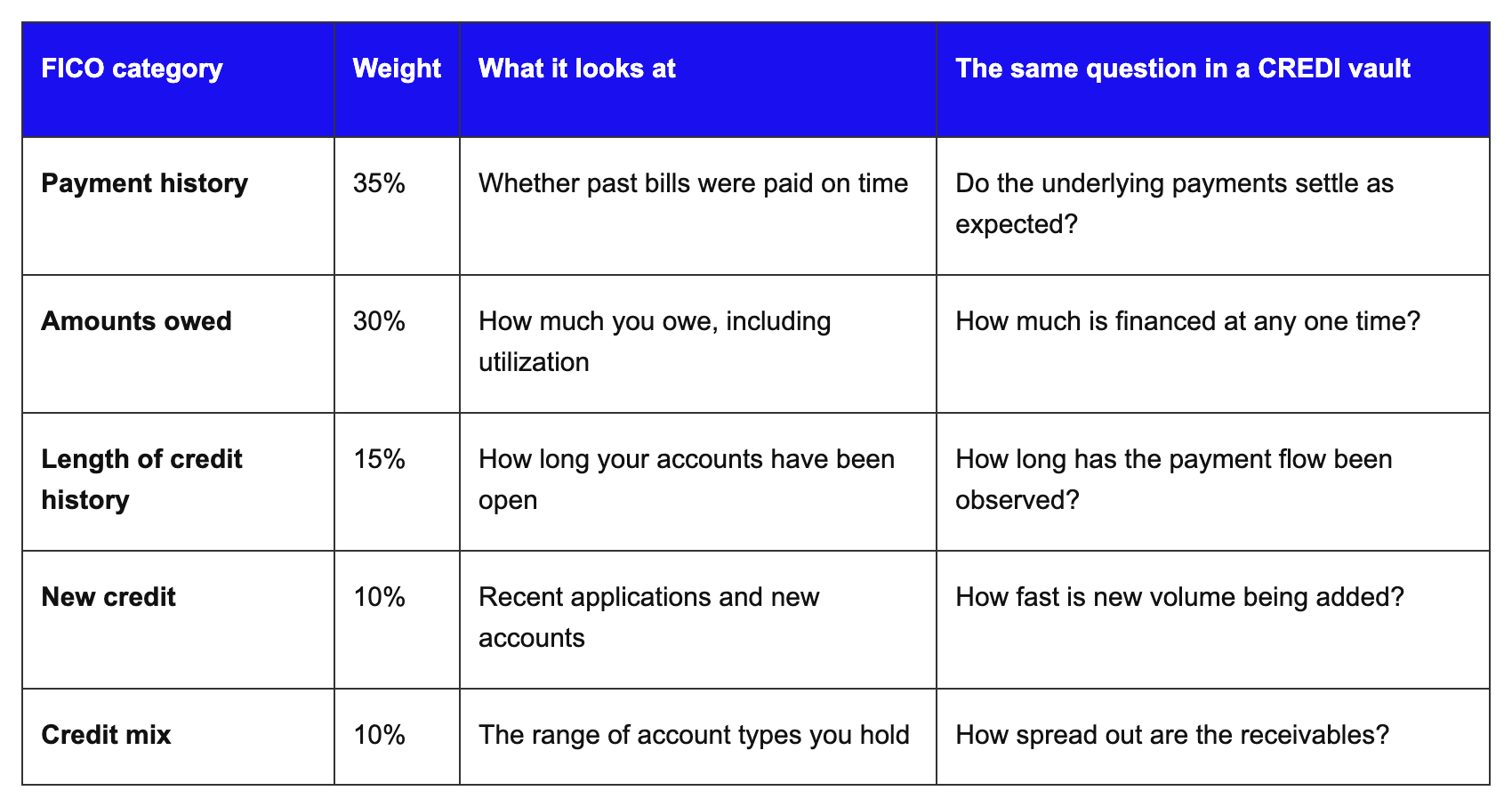
The right-hand column is our own comparison: businesses and receivables get judged with the same instincts, using different data. Judging whether credit should be granted, and on what terms, is called underwriting.
Businesses use credit to cover the wait between a sale and the cash
For a business, credit mostly bridges timing: it covers the gap between paying for costs today and collecting revenue later. A shop pays rent and staff before customers' payments arrive, and a supplier ships goods on 30 or 60 days' terms before its invoice is paid. Each of those gaps is a loan in practice, even when nobody calls it one.
A sale feels finished when the customer pays, yet a card payment still has to travel through networks and banks before it lands in the merchant's account, which takes days. We explain the mechanics in why merchants wait to get paid. That waiting period is exactly what CREDI finances: CREDI finances the wait between a card swipe and its settlement.
Common forms of business credit:
- Business credit cards and lines of credit: revolving credit for day-to-day costs.
- Term loans: installment credit for equipment, expansion or property.
- Trade credit: a supplier lets a buyer pay later, on agreed terms such as 30 or 60 days.
- Receivables financing: capital funds invoices or card payments that are already owed, and is repaid when they settle. CREDI connects onchain capital to this kind of receivable through payment service providers (PSPs), the companies that process card payments.
Each of these follows the same parts as a consumer loan: principal, interest, a term and a source of repayment.
Private credit is lending done outside banks and public markets
Private credit is lending by funds and other non-bank lenders, negotiated directly with borrowers and usually held until it is repaid. It covers everything from loans to mid-sized companies to the receivables financing described above. Our full guide to what private credit is and how it works covers who uses it and why, and our comparison of private credit and private equity shows how the two differ.
The mechanics match consumer credit: a lender, a borrower, principal, interest, a term and a repayment source. The differences are scale, underwriting (lenders run their own checks in place of a consumer credit score) and transparency, because private loans are not priced daily on an exchange and investors depend on the reporting they receive. Regulators are watching closely.
"risks from artificial intelligence (AI), private credit, and persistent inflation" Federal Reserve, Financial Stability Report, May 2026, listing the near-term risks most cited by market contacts
That attention is the reason reporting matters as much as returns. CREDI brings private credit onchain, meaning the vault and its records live on a public blockchain where activity can be checked. We explain the model in what on-chain private credit is.
Where CREDI fits: connecting onchain capital to short-duration receivables
CREDI is infrastructure for private credit: an onchain layer that gives liquidity providers access to short-duration receivables through vaults. LPs deposit stablecoins such as USDC, the vault finances real receivables (card payments and trade invoices), and the return comes from those receivables being repaid when the payments settle, typically within days to weeks.
The setup uses each of the credit parts covered above, with named partners for each job:
- Vault infrastructure: CREDI vaults run on Enzyme vault infrastructure on Ethereum. A vault is a smart contract, a program on the blockchain, that holds deposits and follows set rules.
- Origination: payment service providers (PSPs) and payment partners sit between the vault and the merchants, so CREDI connects capital to receivables they process.
- Verification: Accountable acts as the external attester, an independent party that checks and confirms the state of the book.
- Distribution: Turtle helps bring the vaults to LPs.
As of October 2026, CREDI had $16.37M funded to date with 0 realized losses to date. Past results do not predict future ones, and this is credit: it is not risk free. A payment partner can fail, payments can be disputed or refunded before they settle, and deposits come with lock periods, so money is not instantly available (see liquidity risk in private credit). Anyone considering a deposit should read the vault terms in full.
Frequently Asked Questions
Is credit the same as debt?
They are two sides of the same agreement. Credit is the ability or permission to borrow, such as a $2,000 card limit. Debt is what you actually owe once you use it, such as a $500 balance. You can have plenty of credit available and no debt at all if you pay in full each month.
What happens if a borrower does not repay?
The lender first charges late fees and reports the missed payment to the credit bureaus, which lowers the borrower's score. After a longer period the account can go into default and be sent to collections. For secured credit, the lender can also take the collateral. For investors in credit, an unpaid loan becomes a loss once recoveries are counted.
Why do profitable businesses use credit?
Because profit and cash arrive at different times. A business can be profitable on paper and still short of cash this week, because customers pay later than suppliers and staff need paying. Credit fills that timing gap. Financing receivables is one of the most direct ways to do it, since repayment comes from a payment that is already owed.
Can everyday investors access private credit?
Private credit has mostly been sold to institutions and wealthy investors through funds. Onchain vaults are a newer route, where people deposit stablecoins into a credit strategy directly. Access rules still depend on the product and the investor's country, and the risks of credit, including defaults and lock periods, apply in every format.
Credit is a promise about time
Every form of credit in this guide, from a credit card to a trade invoice, is a promise to pay later, priced for how long the wait is and how sure the repayment looks. If you want to see how short-duration receivables work as an onchain credit strategy, start with CREDI.
Explore CREDI → credilabs.io
This article is for information only and is not financial, investment or legal advice.


