

TL;DR
- Real-world assets (RWAs) are blockchain tokens that give you a claim on something that exists offchain, such as a Treasury bill, a loan, gold or a building. The token is the record, and the value sits in a legal structure held by a custodian.
- The market size depends on what you count. RWA.xyz showed $39.36 billion in tokens that can move between wallets and $391.97 billion that stay on their issuer's platform (November 7, 2026).
- Tokenized Treasuries are the largest category you can hold in your own wallet, followed by private credit and commodities. Real estate gets the headlines and is still small onchain.
- Most RWA risk sits offchain: the legal claim, the custodian and how fast you can exit. Smart contract risk comes on top.
- CREDI sits in the private credit category. Liquidity providers deposit USDC into a CREDI vault, vault capital finances card and trade payments waiting to settle, and the rate is fixed on the day of deposit.
"RWA" now shows up in almost every crypto headline. The same market gets reported as $39 billion in one place and close to $400 billion in another.
The money is real. RWA.xyz tracked 5.67 million holders of tokenized assets on November 7, 2026, and the largest issuers include BlackRock and Franklin Templeton.
This guide explains what RWAs are, which categories exist, how an asset becomes a token and what to check before you hold one. Along the way, we show where CREDI fits as an RWA built on short card and trade payments.
What Are Real-World Assets (RWA) in Crypto?
Real-world assets in crypto are blockchain tokens that represent ownership of, or a claim on, an asset outside the blockchain. Think government bonds, business loans, gold, property or company shares.
The token moves onchain. The asset itself stays with an issuer, a fund or a custodian, under ordinary law.
Tokenization is the process of creating that token. An issuer places the asset in a legal structure, often a fund or a special purpose vehicle (SPV), a company set up only to hold one asset or pool.
The issuer then mints tokens, meaning it creates them on a blockchain, to track each holder's share. You can keep the token in a crypto wallet, use it in DeFi (decentralized finance, apps that run on smart contracts) or redeem it with the issuer.
The appeal is practical. A tokenized fund can settle at any hour, be held in small amounts and connect to other onchain apps.
The asset keeps the same risks it had before it became a token. A simple way to picture it:
- Onchain: the token, transfers, balances and the smart contract rules.
- Offchain: the asset, the legal claim, the custodian and the income it produces.
- The link between them: the issuer's reports, audits, attestations and oracles.
CREDI follows the same split. Vault deposits and activity are recorded onchain, and the asset underneath is real card and trade payments waiting to settle.
How Big Is the RWA Market?
The RWA market measured about $39 billion or about $392 billion on November 7, 2026. The answer depends on whether you count only tokens that can leave their issuer's platform.
RWA.xyz, the most cited public data source for tokenized assets, introduced this split in November 2025.
Distributed assets can be moved to wallets outside the issuing platform and sent between wallets, even if only to approved holders. Represented assets stay on the platform, and the blockchain works mainly as a record book for the institution that issued them.
| Measure (RWA.xyz, Nov 7, 2026) | Value | What it tells you |
|---|---|---|
| Distributed assets | $39.36B | Tokens you can hold in your own wallet and transfer |
| Represented assets | $391.97B | Assets recorded on a chain and locked to the issuer's platform |
| Holders | 5.67M | Wallets holding at least one tracked RWA |
| Stablecoins (counted apart) | $281.62B | Dollar tokens, reported outside the RWA totals |
For an investor, the distributed figure is usually the one that matters. A represented asset may be perfectly sound, and you still can't move it into DeFi or sell it to another wallet.
So when a report says "tokenized assets reached $400 billion," most of that money sits in closed systems. A useful first test for any RWA token: can it leave the platform that issued it?
CREDI vault deposits are made in USDC, a distributed stablecoin, and every deposit and repayment is recorded onchain.
Treasuries Lead, Private Credit Follows
Tokenized US Treasuries are the largest distributed RWA category, followed by private credit and commodities. Together these three made up about $27.7 billion of the $39.36 billion distributed total on November 7, 2026.
Equities, funds and real estate share the rest.
| Category | What the token represents | Distributed value (Nov 7, 2026) |
|---|---|---|
| Tokenized Treasuries | Shares in funds holding short-term US government debt | $14.11B |
| Private credit | Loans and receivables owed by real businesses | $8.22B |
| Commodities | Mostly gold held in vaults | $5.35B |
| Real estate | Shares in property or property funds | Small; largest token about $95M |
Tokenized Treasuries are funds that hold short-dated US government debt and pass the interest to token holders. The largest include Ondo USDY, Circle USYC and BlackRock BUIDL.
The average 7-day yield across the category was 3.60% on November 7, 2026, according to RWA.xyz. DAOs, crypto funds and stablecoin issuers use them to earn a dollar yield without leaving the chain.
Private credit means loans made by lenders outside the banking system, from business loans to invoices and card receivables. Receivables are money a business is owed for sales it already made.
Private credit is also the category where checking the borrower matters most. RWA.xyz counted another $42.55 billion of it as represented.
Our guide to onchain private credit explains how it works, who pays and what can go wrong.
Commodities are mostly gold. Tether Gold (XAUT) and Paxos Gold (PAXG) lead, and each token tracks a set weight of metal held by a custodian.
Real estate was the original pitch for tokenization. Onchain it is still a niche, because property is slow to transfer under local law and hard to value every day.
CREDI belongs in the private credit row. Its vaults finance card and trade payments that settle in days to weeks.
How this connects to CREDI
CREDI is infrastructure for private credit: an onchain layer that connects capital from liquidity providers (LPs) to real-world receivables. In RWA terms, those receivables are the real asset, and the vault is how capital reaches them.
LPs deposit stablecoins such as USDC, digital dollars designed to hold a value of $1, into a CREDI vault. Vault capital finances card and trade payments waiting to settle, the vault is repaid when each payment settles, and LPs get a fixed rate set on the day of deposit.
Keep reading: the next sections cover the stablecoin debate, how tokenization works step by step, how oracles and attestations report what backs a token, and the main risks. If private credit is new to you, start with what private credit is.
Are Stablecoins Real-World Assets?
Stablecoins are backed by real-world assets, and whether they count as RWAs depends on who is counting. The choice changes the market size by about seven times.
- Counted in: CoinGecko's RWA guide (July 2026) includes dollar-backed stablecoins and puts the combined market above $320 billion as of the first quarter of 2026.
- Counted apart: RWA.xyz shows stablecoins on their own dashboard ($281.62 billion on November 7, 2026) and leaves them out of its RWA totals.
- The case for counting them: a dollar-backed stablecoin claims dollars held in bank deposits and Treasuries offchain. Circle holds most USDC reserves in the Circle Reserve Fund, a registered government money market fund, with monthly checks by a Big Four accounting firm.
- The case for separating them: stablecoins work as cash, pay holders no yield and are large enough to drown out every other category.
A practical way to read it: stablecoins are the cash layer of the RWA market. They are the money you use to buy a tokenized Treasury fund or to fund a credit vault.
That is exactly the role USDC plays at CREDI. LPs deposit it, and vault capital finances real payments that earn the fixed rate.
How Does Tokenization Work?
When an asset is tokenized, the token gives you a claim on a legal structure that holds the asset. The bonds stay with a fund's custodian, the gold stays in a vault and the loans stay on a lender's books.
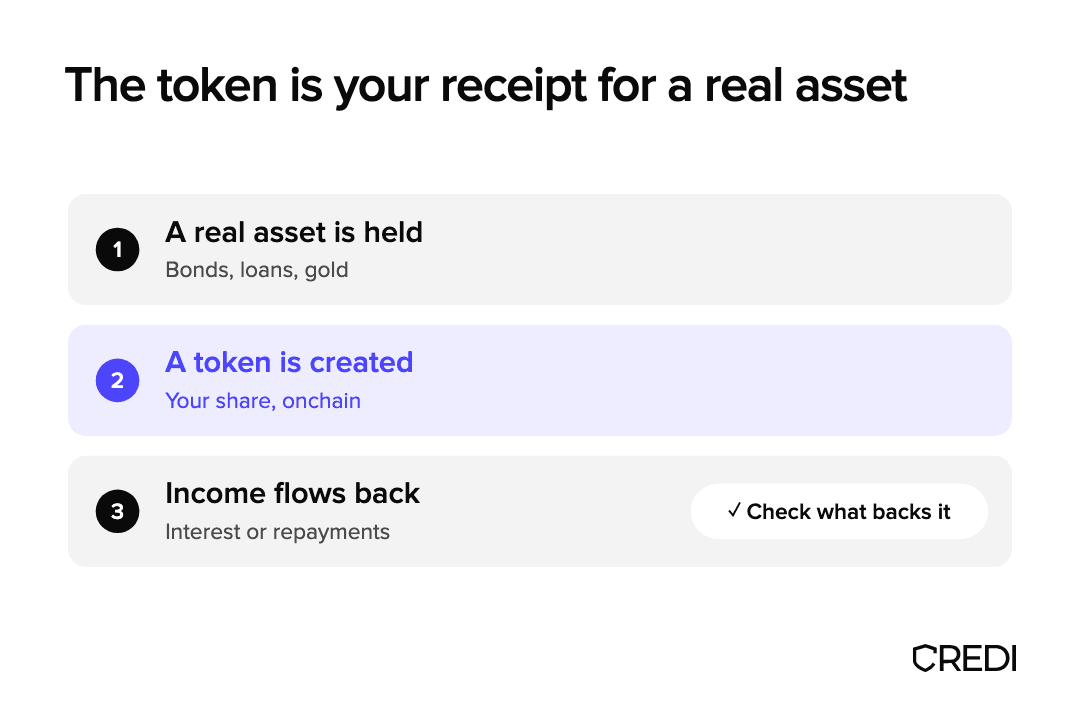
What changes is how ownership is recorded and passed on. Most RWA tokens follow the same steps:
- Structure: the issuer places the asset in a fund, trust or SPV under a specific country's law.
- Custody: a regulated custodian or bank holds the asset or the cash.
- Minting: a smart contract creates tokens matching investors' shares, often only for wallets that passed identity checks (KYC, "know your customer").
- Reporting: the issuer, an auditor or an oracle publishes what backs the tokens.
- Income and exit: interest, rent or repayments flow to holders, and holders exit by redeeming with the issuer or selling the token.
A quick example shows where the onchain part stops. Say you hold $10,000 of a tokenized Treasury fund paying 3.60% a year (illustrative, using the November 2026 category average).
Over a year that is about $360 before fees, or roughly $0.99 a day. The smart contract can update your balance daily, and the interest still only exists because the US government pays the Treasury bills a custodian holds.
A CREDI vault works on the same principle. The vault records deposits onchain, and the return comes from card and trade payments that settle in the real world.
How Do Oracles and Attestations Back an RWA?
A blockchain can't see a bank account or a gold vault, so RWA tokens rely on oracles and attestations to report what backs them.
An oracle is a service that brings offchain data onto a blockchain. An attestation is a statement, often from an accountant or independent checker, that confirms a set of facts at a point in time.
Chainlink's Proof of Reserve is one widely used example. It publishes reserve data onchain so smart contracts can check that a token's supply matches its backing, and gold token issuers such as Paxos use it (Chainlink).
The data is only as good as its source. Chainlink describes Proof of Reserve as using "data generated by professional auditors."
A feed sourced from an independent auditor tells you more than one sourced from the issuer's own system. How often it updates matters too, since some feeds only update when reserves move past a set threshold.
In credit, the same idea applies to a loan book: what was funded, what was repaid and what is late, checked by someone other than the lender. CREDI's book is attested by an independent party, meaning an outside firm checks and confirms the data.
We explain why this matters more in credit in why private credit needs a different kind of transparency.
What Are the Risks of RWA Tokens?
The biggest risks in RWA tokens come from the legal claim, the custodian and liquidity, with smart contract risk on top.
IOSCO, the global group of securities regulators, said in its November 2025 report on tokenization that tokenized assets carry the same kinds of risk as traditional ones. Those risks can simply show up in new ways on a blockchain.
- Legal claim: the token may give a weaker claim than you assumed, or none if the issuer goes bankrupt. The offering documents say who legally holds the asset and which law applies.
- Custody: the custodian could fail or the backing could be missing. Named custodians and independent attestations reduce this risk.
- Liquidity: liquidity means how quickly you can turn a holding back into cash. Many RWA tokens trade rarely, so the real exit is redemption on the issuer's schedule.
- Smart contracts: a bug, a misused admin key or a wrong oracle price can move funds. Public audits and clear upgrade controls help.
- The asset itself: a borrower can default, gold can fall and rates can drop. The token changes none of that.
A higher yield usually means more risk in the asset underneath. Our piece on the illusion of yield explains why the source of a yield matters.
These risks apply to CREDI too. Payments can be refunded, disputed or fail to settle, a partner in the payment chain could fail, and smart contracts and stablecoins carry technical risk.
In exchange, the receivables are short, the rate is fixed at deposit and activity is recorded onchain. LPs choose a lock period of 3 to 24 months at deposit (published terms, November 2026), so the exit date is known from day one.
Where CREDI Fits in the RWA Market
CREDI sits in the private credit category of real-world assets. It connects LP capital to real receivables: card and trade payments that settle in days to weeks.
- The asset: card and trade payments waiting to settle, a short and real form of credit.
- The deposit: LPs deposit USDC and choose a lock period of 3 to 24 months.
- The rate: fixed on the day of deposit.
- The reporting: activity is recorded onchain, and the book is attested by an independent party.
- The record so far: $16.37M funded to date with 0 realized losses to date, as of October 2026.
Past results don't guarantee future ones. Private credit carries real risk, which is why short duration and independent checks matter.
Frequently Asked Questions
What does RWA stand for in crypto?
In crypto, RWA stands for real-world asset: a token that represents an asset outside the blockchain, such as a Treasury bill, a loan, gold or property.
In banking, the same letters mean risk-weighted assets, a measure regulators use to set how much capital a bank must hold.
Are RWA tokens the same as RWA coins?
They are different things. An RWA token represents a claim on a specific asset, such as a share in a Treasury fund.
"RWA coins" usually means the tokens of projects that build tokenization platforms. Their price follows the project and the market, and they give you no claim on any underlying asset.
Can anyone buy tokenized real-world assets?
It depends on the product. Many tokenized funds are limited to qualified investors and to wallets that passed identity checks, and some are closed to US persons.
Gold tokens and some yield-bearing dollar tokens are open to a wider audience. Each issuer publishes its own eligibility rules.
Which blockchain hosts the most RWAs?
Ethereum holds the largest share. On November 7, 2026, it hosted $15.12 billion of distributed RWAs, about 38% of the total, followed by BNB Chain and Solana (RWA.xyz).
How does CREDI fit into real-world assets?
CREDI is an RWA in the private credit category. LPs deposit USDC into a CREDI vault, and vault capital finances card and trade payments waiting to settle.
The vault is repaid when each payment settles, and LPs earn a fixed rate set on the day of deposit.
Put Real-World Payments Behind Your Stablecoins
An RWA token is only as good as the legal claim, the custodian, the reporting and the asset behind it. Check those before the yield, and check whether the token can leave its issuer's platform.
CREDI connects LP capital to short-duration card and trade payments, with a fixed rate set at deposit, an independently attested book and activity recorded onchain. To see how it works, explore CREDI →
This article is for information only and is not financial, investment or legal advice.


