

TL;DR
- Fixed income means lending money in exchange for a set schedule of interest payments and your money back at the end. The global bond market held $160.7 trillion of debt at the end of 2025, more than the global stock market.
- The main types are Treasuries, municipal bonds, corporate bonds and private credit. They differ by who borrows, for how long, and how easily you can sell.
- Four numbers explain almost any fixed income investment: the coupon, the yield, the duration and the credit rating.
- The rate can be fixed or floating. Most private credit funds use floating rates, which move with the market.
- CREDI brings fixed income onchain. Liquidity providers deposit USDC into a CREDI vault, the capital finances short-term card and trade payments, and the rate is fixed on the day of deposit.
The bond market is bigger than the stock market. Global fixed income debt reached $160.7 trillion at the end of 2025, while global stocks were worth $157.8 trillion (SIFMA Capital Markets Fact Book, August 2026).
Most people still meet it only as a line called "bonds" in a retirement plan.
A handful of ideas runs through every kind of fixed income, from a 4-week government bill to a loan that finances card payments. This guide explains them in plain words, and shows where CREDI fits.
What Is Fixed Income?
Fixed income is an investment where you lend money to a borrower and get a set schedule of interest payments, plus your money back at an agreed date. The borrower can be a government, a company or another business.
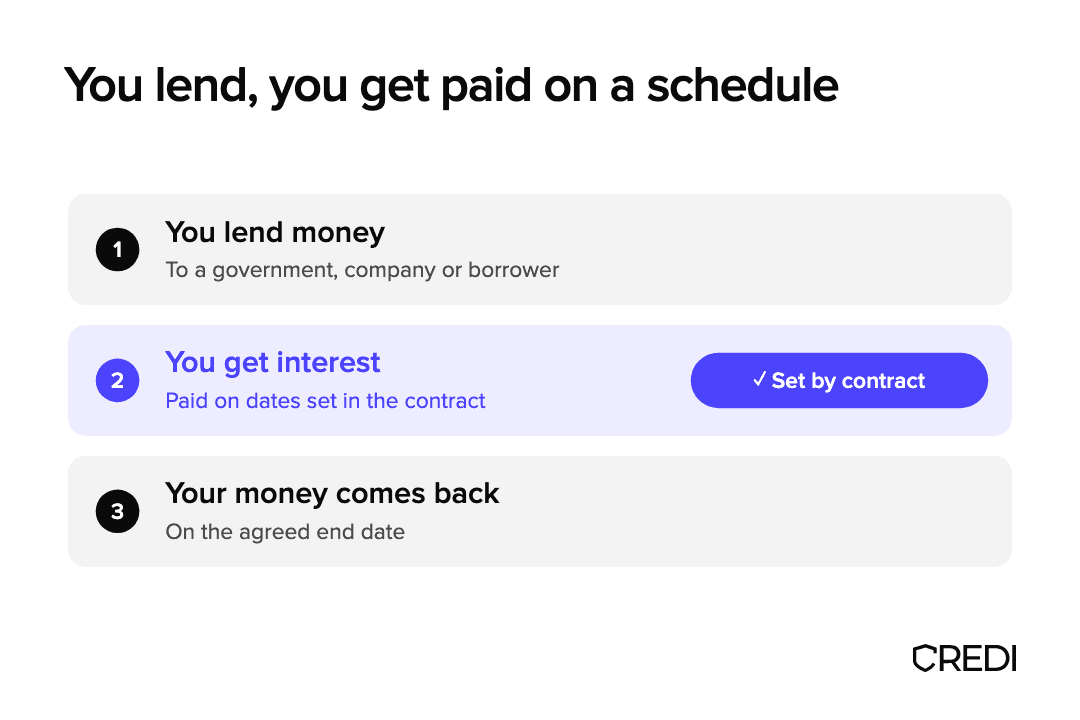
Your return is set by a contract. That contract is what sets fixed income apart from stocks, where your return depends on how the company does.
"Income" refers to the interest payments. "Fixed" refers to the schedule: you know in advance how much you are owed and when.
That predictability is why pension funds, insurers and central banks hold so much of it. A few terms do most of the work:
- Principal: the amount you lend, also called the face value. You get it back at the end if the borrower pays.
- Coupon: the interest rate agreed when the bond is issued. It is your income.
- Maturity: the date your principal is due back.
- Yield: the return you actually earn at today's price. It moves when market rates move.
- Duration: how much the price moves when interest rates change, measured in years.
- Credit rating: a grade from an agency on how likely the borrower is to pay.
A CREDI vault works on the same contract logic. An LP (liquidity provider, the person or fund putting money in) knows the rate on the day of deposit and the lock period they chose.
The Main Types of Fixed Income
The biggest difference between fixed income investments is the borrower. The borrower decides how likely you are to be repaid.
As the borrower gets riskier or harder to look into, the yield goes up and selling quickly gets harder.
| Type | Who borrows | Main risk |
|---|---|---|
| U.S. Treasuries | The federal government | Interest rate moves |
| Municipal bonds | States, cities and agencies | Rates and credit |
| Investment grade bonds | Large companies rated BBB or better | Rates and credit |
| High yield bonds | Companies rated BB or below | Credit |
| Certificates of deposit | Banks | Inflation |
| Private credit | Private businesses, through nonbank lenders | Credit and liquidity |
Read the table from top to bottom. The yield a borrower must pay and the work it takes to judge them rise together.
CREDI sits in the private credit row. Its vaults fund short-term receivables, money that is already owed for card and trade payments and arrives within days to weeks.
Treasuries Set the Baseline
U.S. Treasury securities are loans to the federal government. FINRA calls them "among the safest investments you can make" (FINRA, Bonds).
Because the chance of default is treated as close to zero, their yield is the starting point for pricing every other dollar loan.
If a company borrows at 6% while a Treasury of the same length pays 4%, the 2-point gap is called the credit spread. It is the extra pay investors want for that company's risk.
The Treasury sells several formats, mainly sorted by length and how interest is paid (TreasuryDirect):
- Bills: 4 to 52 weeks, sold below face value, with the full value paid at the end.
- Notes: 2 to 10 years, paying interest every six months.
- Bonds: 20 and 30 years, paying interest every six months.
- TIPS: 5, 10 and 30 years, with the principal adjusted for inflation.
- Floating Rate Notes: 2 years, with a rate that resets with the 13-week bill.
Any yield, including a CREDI vault's fixed rate, is easiest to read next to this baseline. Our guide to what yield is explains how to compare them.
Corporate Bonds Pay More for More Risk
Corporate bonds pay more than Treasuries because a company can run out of money. Investors want to be paid for carrying that chance.
Companies issue them to fund equipment, day-to-day operations and acquisitions (FINRA).
Rating agencies grade each company. Bonds rated BBB or better by S&P (Baa by Moody's) are investment grade.
Bonds rated BB or below are high yield, sometimes called junk. FINRA puts the trade-off simply:
"A high-yield bond generally pays a higher return (yield) than a bond with an issuer that carries lower default risk." FINRA, Bonds
Bondholders also stand ahead of shareholders. If a company goes bankrupt, they are more likely to get some of their money back (FINRA).
The same idea applies to receivables finance. The return depends on who owes the money, and card payments have a clear payer in the card network.
How this connects to CREDI
CREDI is infrastructure for private credit: an onchain layer that connects capital from liquidity providers to real-world receivables. In fixed income terms, it is a lending product with a set rate and a set lock period.
LPs deposit USDC, a stablecoin (a digital dollar designed to hold a value of $1), into a CREDI vault. Vault capital finances card and trade payments waiting to settle, and the vault is repaid when each payment settles.
LPs get a fixed rate set on the day of deposit.
Keep reading: the next sections explain why bond prices move with interest rates, what duration means, how fixed and floating rates differ, and how onchain private credit works. If private credit is new to you, start with what private credit is.
Why Bond Prices Move When Rates Change
A bond's coupon never changes after it is issued. So when market interest rates rise, an older bond can only offer a competitive yield if its price falls.
FINRA's summary: "bond prices and interest rates move in opposite directions" (FINRA).
Take three bonds, each worth $1,000 and paying a 4% coupon ($40 a year). Market rates for similar bonds then rise to 5%.
A new buyer now wants 5%, so each price drops until its yield matches:
| Bond (illustrative) | Price after rates rise to 5% | Change |
|---|---|---|
| 2-year, 4% coupon | $981.41 | -1.9% |
| 10-year, 4% coupon | $922.78 | -7.7% |
| 30-year, 4% coupon | $846.28 | -15.4% |
Illustrative figures, annual coupons, calculated by CREDI. Not a forecast.
Same coupon, same rate move, very different results. If you hold any of them to the end and the borrower pays, you still collect every coupon and your $1,000.
The price drop hurts when you sell early, or when a fund values its holdings at today's prices.
A CREDI LP's rate is set at deposit and stays the same for the lock period, so market rate moves after deposit don't change it.
What Duration Tells You
Duration measures how sensitive a bond's price is to interest rates, in years. The higher the number, the bigger the price swing.
FINRA's rule of thumb: a bond with a duration of 10 loses about 10% of its price if rates rise by 1 percentage point, and gains about 10% if they fall by the same amount (FINRA, Brush Up on Bonds).
Duration grows with the time left until maturity. A higher coupon lowers it, because more of your money comes back sooner.
- Under 1 year: bills, money market funds and short-term receivables. Rate moves barely touch the price.
- 1 to 7 years: short and medium notes, the core of most bond funds.
- Over 7 years: long bonds, where a 1-point move can mean a double-digit price change.
Receivables finance lives at the short end. A payment due in 30 days has a duration of about 0.08 years, so a 1-point rate rise moves its value by about 0.08% (illustrative).
At that length, the main question becomes simple: will the payment arrive? That is the question CREDI focuses on, since card payments settle in days and problems show up fast.
Fixed Rate and Floating Rate
Fixed income is defined by the contract to pay you on a schedule. The rate inside that contract can be fixed, or floating, meaning it resets with a market benchmark.
Treasury Floating Rate Notes are one floating example. Private credit is a bigger one.
Private credit means loans "negotiated directly between a borrower and a small group of nonbank lenders" (New York Fed, The Teller Window). Funds doing this manage more than $2.5 trillion globally (BIS Quarterly Review, March 2025).
Their main strategy, direct lending, uses what the BIS calls "covenant-heavy floating rate loans". Most of these funds also lock investor money for five to eight years.
CREDI sets the rate on the day you deposit and keeps it for the lock period you choose, from 3 to 24 months (published terms, November 2026). The underlying receivables are short, so the vault pairs a fixed number with a very low duration.
Our piece on why CREDI's fixed income offering is more relevant than ever goes into why that matters now.
Fixed Income and Stocks
Fixed income gives you a contractual claim to a set stream of payments. A stock gives you ownership of what is left after everyone with a claim has been paid.
- What you own: a loan to the borrower, or a slice of the company.
- Where the return comes from: agreed interest and principal, or dividends and price growth.
- Upside: capped at the agreed payments for a loan, open-ended for a stock.
- In bankruptcy: lenders are paid before shareholders, who often get nothing.
- Role in a portfolio: income and stability for fixed income, long-term growth for stocks.
Most portfolios hold both, with the mix set by time horizon and the need for income.
CREDI's vaults sit on the fixed income side. The return comes from short-term card and trade payments, which follow their own settlement schedule.
How Onchain Fixed Income Works
Onchain private credit is lending to real businesses where deposits and repayments are recorded on a blockchain, a shared public ledger anyone can inspect. Checking the borrowers, called underwriting, still happens offchain.
The contract works like any fixed income claim: money goes out, scheduled payments come back. What changes is the plumbing:
- How you invest: a stablecoin deposit into a vault, often with lower minimums than a traditional fund.
- Rate: set by each vault's terms, fixed at deposit in CREDI's case.
- Reporting: onchain records anyone can check, plus independent attestation, an outside firm confirming the data, where offered.
- Lock period: set by each vault's terms.
The blockchain makes the money flows visible and settlement fast. Loan quality comes from underwriting and from independent checks on what's reported.
Our guide to what onchain private credit is goes deeper.
In CREDI's case, the book is attested by an independent party and vault activity is recorded onchain. As of October 2026, CREDI has funded $16.37M to date with 0 realized losses to date.
Past results don't guarantee future ones. Main risks include payments that arrive late or fail to settle, a partner in the payment chain failing, smart contract and stablecoin risk, and money being locked for the period chosen.
Frequently Asked Questions
What are typical fixed income returns?
Returns depend on the borrower, the length and current interest rates. Short-term Treasuries follow the Federal Reserve's policy rate.
Investment grade bonds add a credit spread, high yield bonds add more, and private credit usually pays more again for less liquidity and more credit risk.
Is fixed income a good investment when rates are high?
High rates mean new bonds pay more income, so new buyers lock in better yields. People who bought earlier see their bonds lose market value as rates rise.
Short-duration holdings feel that effect the least.
Can you lose money in fixed income?
Yes. You can lose money if the borrower defaults, if you sell after rates have risen, or if inflation runs above your yield.
Holding a high-quality bond to the end removes the price risk. Credit risk remains until the final payment arrives.
What is the difference between a bond and a bond fund?
A bond has an end date: hold it and, if the borrower pays, you get your principal back. A bond fund keeps replacing bonds as they mature and has no end date, so its price keeps moving with rates.
Are stablecoin yields a form of fixed income?
They are when the yield comes from a lending contract with scheduled payments. Some stablecoin yields come from token rewards or trading, which behave differently.
Our piece on the illusion of yield explains why the source matters.
How does CREDI fit into fixed income?
CREDI offers fixed income onchain. LPs deposit USDC into a CREDI vault, choose a lock period of 3 to 24 months, and get a fixed rate set on the day of deposit.
Vault capital finances short-term card and trade payments, and the vault is repaid when each payment settles.
Fixed Income Starts With Who Owes You
Every fixed income decision comes back to the same short list: who is borrowing, for how long, at what rate, and how you will know the payments are real.
CREDI answers that list with short-term card and trade receivables, a fixed rate set at deposit and activity recorded onchain. To see how it works, explore CREDI →
This article is for information only and is not financial, investment or legal advice.


