

TL;DR
- Yield is the income an investment pays you over a year, shown as a percentage of what the investment costs. It lets you compare a savings account, a bond, a stock and a stablecoin vault on one scale.
- Every yield has a payer. A bank, a government, a company or a business pays you because it is using your money, and the size of the yield tells you how much it values that money and how much risk you carry.
- Yields vary widely in practice. In fall 2026 the average U.S. savings account paid 0.38% while a 3-month Treasury bill yielded 4.32%, so where you park cash matters.
- Yield and return are different numbers. Yield counts income only, return adds gains or losses in price, and real yield subtracts inflation to show what your money actually buys.
- In crypto, a stablecoin pays nothing by itself just for being held. Stablecoin yield has to come from putting the coins to work, such as financing real-world receivables, and the source decides the risk.
Yield is the number most people check first and understand least. On October 19, 2026, the FDIC put the national average savings rate at 0.38% a year (FDIC, National Rates and Rate Caps, October 2026). On November 12, 2026, a 3-month U.S. Treasury bill yielded 4.32% (U.S. Treasury, Daily Par Yield Curve Rates, November 2026). On $10,000, that is roughly $38 a year against roughly $432 (illustrative, before tax and compounding).
The gap exists because yield is a price: what someone pays to use your money for a period of time. Once you see who is paying and why, you can read a bond quote, a dividend stock or a stablecoin vault with the same set of questions.
This guide covers what yield means, how it works across stocks, bonds, savings and crypto, how it differs from return, and where CREDI's yield comes from.
What is yield in finance?
Yield is the income an investment produces over a set period, usually a year, expressed as a percentage of the amount invested or of the investment's current price. It covers interest and dividends and leaves out gains or losses in the price itself. The basic formula is simple: annual income divided by price, times 100.
The SEC's investor site defines it for bonds as "the annual percentage rate of return earned on a bond" (Investor.gov, Glossary: Yield). The same idea stretches to every asset that pays income. A savings account that pays $40 a year on $1,000 yields 4%. A share priced at $50 that pays $2 a year in dividends also yields 4% (illustrative). A CREDI vault states its yield as a fixed annual rate, set on the day you deposit.
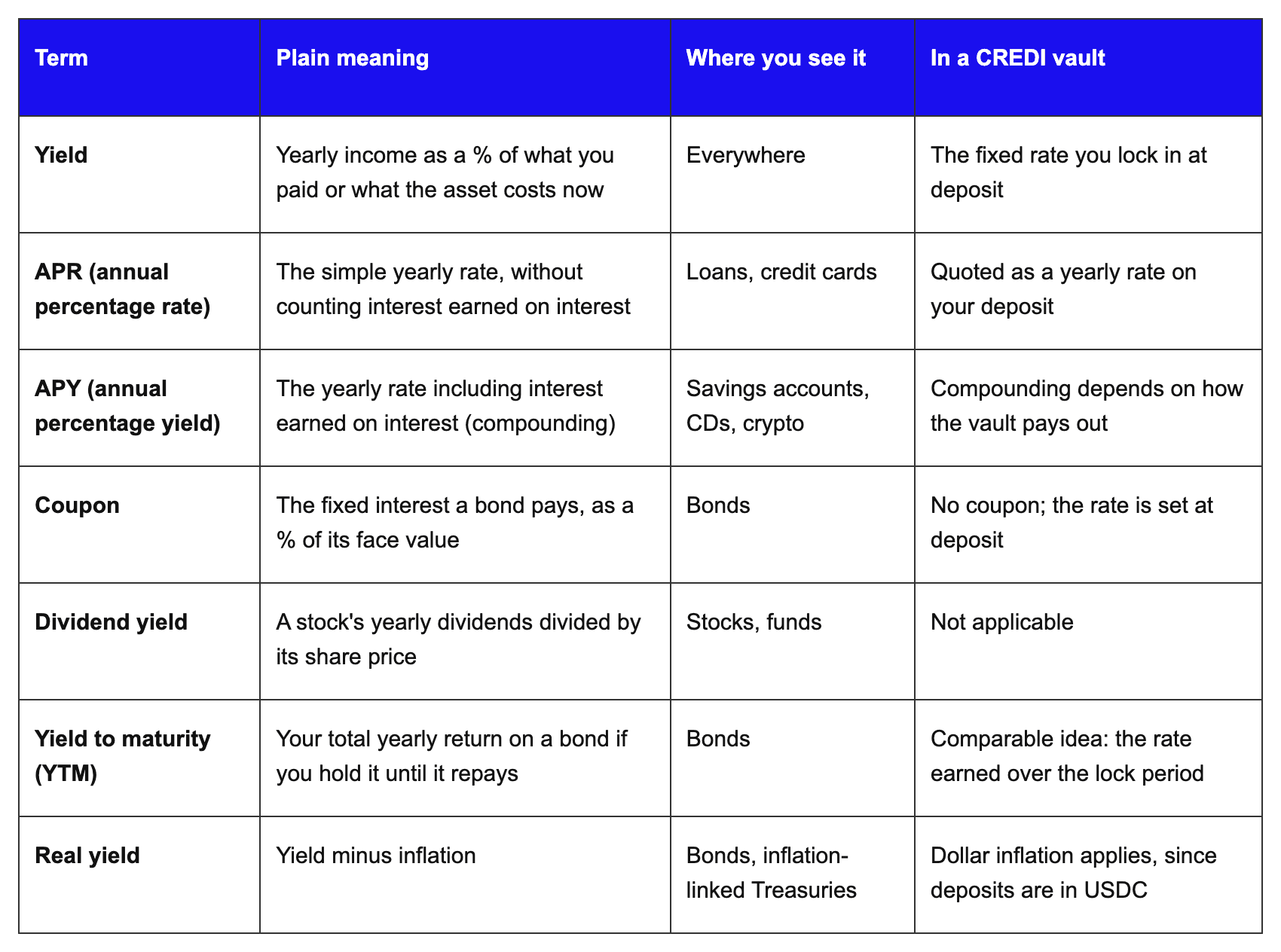
Finance uses several yield terms, and each one answers a slightly different question:
Every yield has a payer: someone pays to use your capital
Yield appears when someone else uses your money and pays you for the privilege; if you cannot name who pays, you cannot judge whether the yield will last. A bank pays depositors because it lends their money out at a higher rate. A government pays bondholders to fund its spending. A company pays dividends from its profits. Each payer has a reason, and the reason sets both the size of the yield and the risk.
This question decides whether a yield lasts. A yield is a promise backed by someone's cash flow, so the quality of the yield equals the quality of that cash flow. A government that can tax pays reliably; a company with falling sales may cut its dividend; a protocol paying rewards in its own token pays only as long as the token holds value. Here is who pays in the most common cases:
- Savings account or CD: the bank, out of the interest it earns on loans.
- Treasury bill or bond: the U.S. government, out of tax revenue and new borrowing.
- Corporate bond: a company, out of its operating cash.
- Dividend stock: a company, out of profits it chooses to share. Dividends can be cut.
- Rental property: tenants, through rent.
- CREDI vault: the financing of card and trade receivables, repaid when those payments settle. CREDI finances the wait between a card swipe and its settlement.
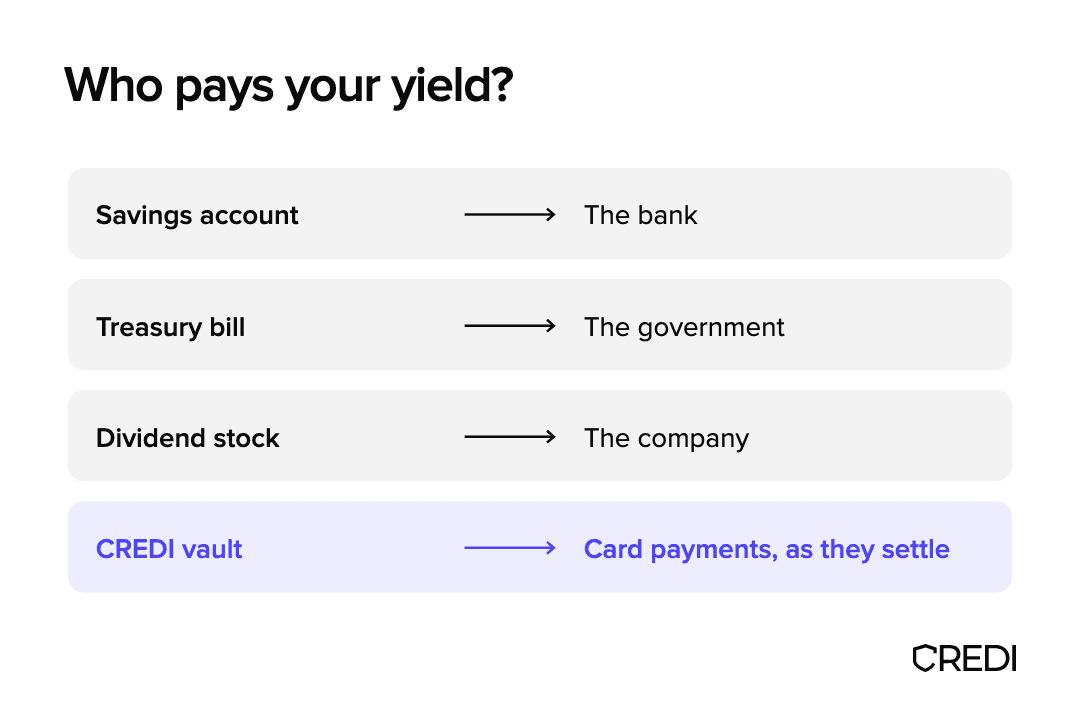
In the CREDI case the payer is real-world economic activity. Card payments take days to settle, and businesses value having that money sooner, so payment partners pay to have the wait financed. That value becomes the yield, and the money that repays it arrives when the card payment settles. Because each payment settles within days to weeks, the cash that backs the yield comes back on a short, regular cycle.
Yield works differently in stocks, bonds, savings and crypto
The idea behind yield is the same everywhere, but the math and the risks change by asset class. A savings rate can change whenever the bank decides. A bond's yield moves with its market price. A dividend yield moves with the share price and the company's payout decisions. A crypto yield depends entirely on what the protocol does with your coins.
Here is how the main asset classes compare, using U.S. figures from fall 2026 where an official source exists:
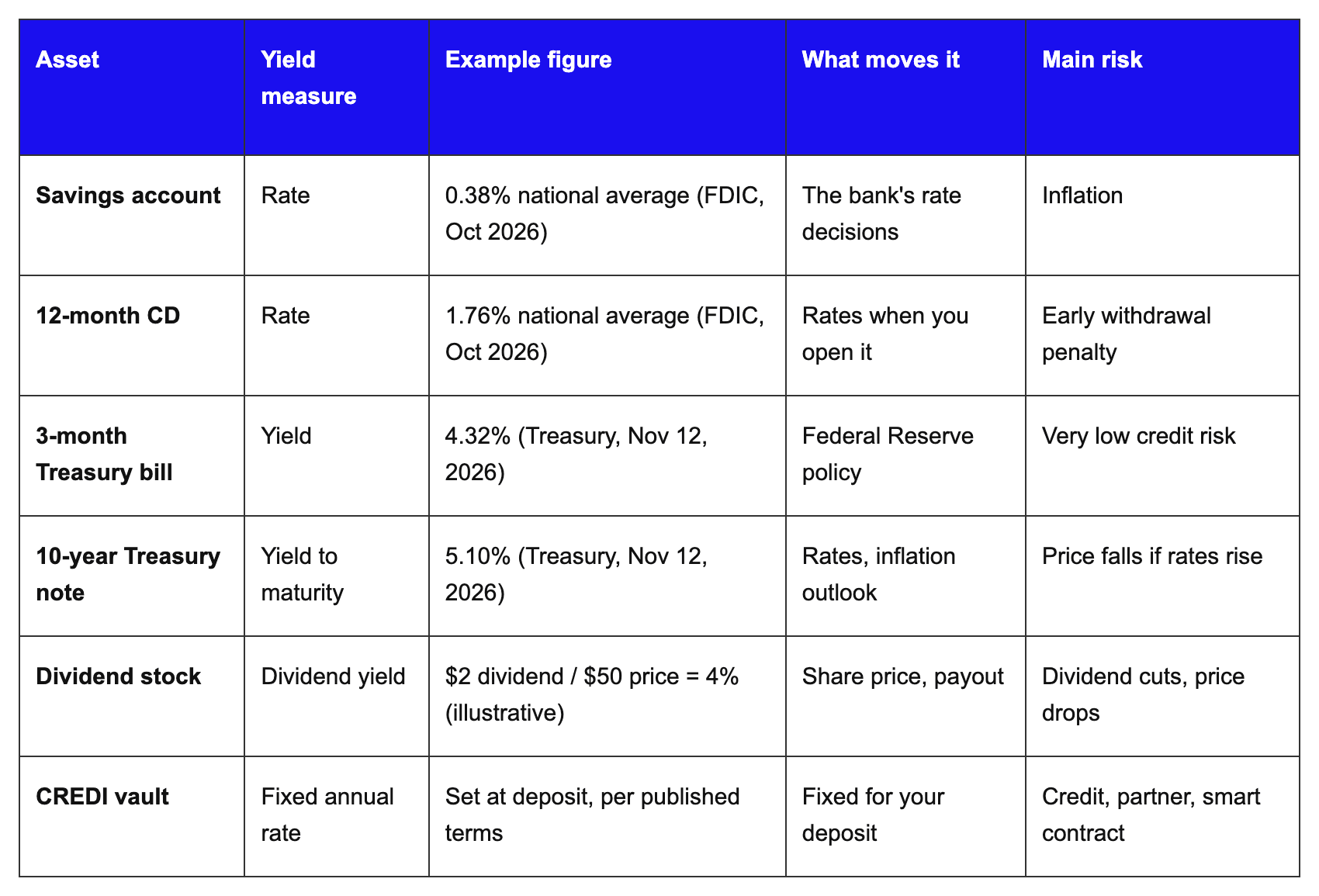
The table shows a pattern worth remembering. Bank deposits paid far less than a Treasury bill of similar length, so where you put cash matters as much as the level of interest rates. Further down the table, extra yield is compensation for extra moving parts.
Bond yields move opposite to bond prices
When a bond's price falls, its yield rises, because the same fixed coupon now buys a cheaper bond. The SEC compares bond prices and market interest rates to "opposing ends of a seesaw" (SEC, Investor Bulletin: What Are Corporate Bonds?, June 2013). This seesaw is why a bond can have three different yield numbers at once.
Take the SEC's own example. A 10-year bond with a $1,000 face value pays a 4% coupon, $40 a year. If its price drops to $900, buyers still get $40 a year and $1,000 at the end. Three yields follow:
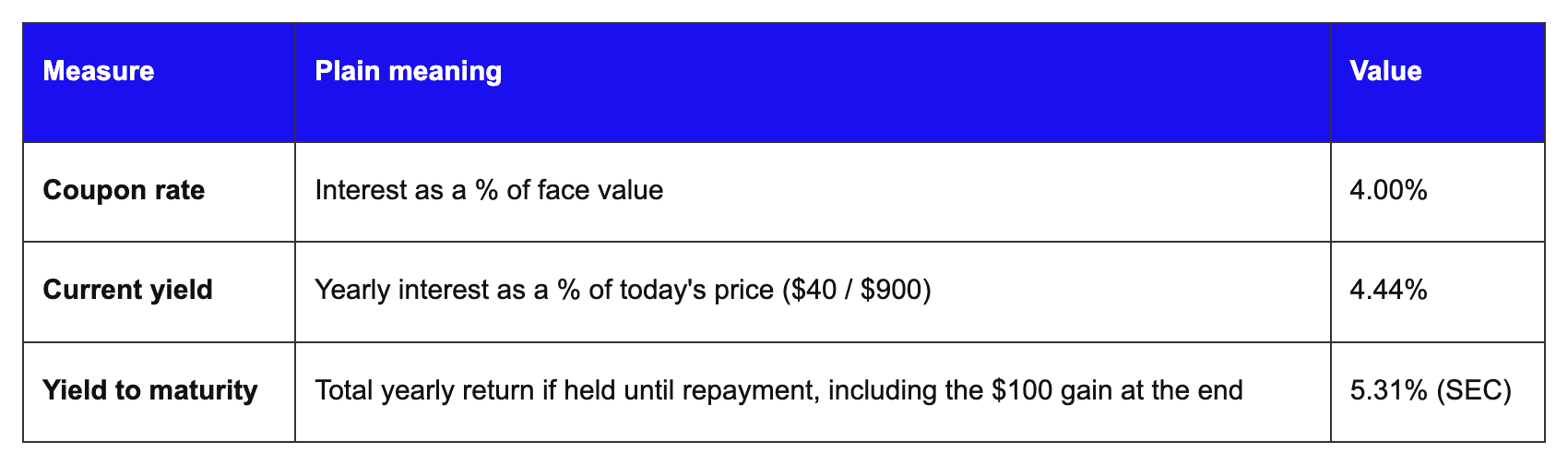
Current yield calculated by CREDI from the SEC example.
Investor.gov defines current yield as the ratio of the bond's interest to its market price, and the SEC calls yield to maturity "a widely used measure to compare bonds." Yield to maturity is the most complete of the three, since it includes both the coupons and the price you paid.
How this connects to CREDI
Bonds show why one investment can quote three yields: when the price moves, the yield moves with it. A CREDI vault quotes a single number, a fixed rate set on the day you deposit, and that yield comes from financing the wait between a card swipe and its settlement. The receivables behind it settle in days to weeks, so the question that matters is the same one any bond investor asks: do the payments arrive on time?
Keep reading: the next sections separate yield from total return, subtract inflation to get real yield, and explain why a higher yield always means more risk. That last section ends with four questions you can ask about any yield, CREDI's included. For a closer look at where unsustainable yields come from, see the illusion of yield.
Yield vs return: income vs the whole result
Yield measures the income an investment pays; return measures everything you gained or lost, including changes in price. A stock can yield 4% in dividends and still return -10% for the year if its price drops 14%. A bond can yield 5% and return more than that if rates fall and its price rises.
A return looks back at what happened, while a yield looks forward at the income you expect. Yield is also the easier number to compare across assets, because it ignores price moves that nobody can predict. That makes yield useful for comparing options before you invest, and return the number that tells you how it actually went.
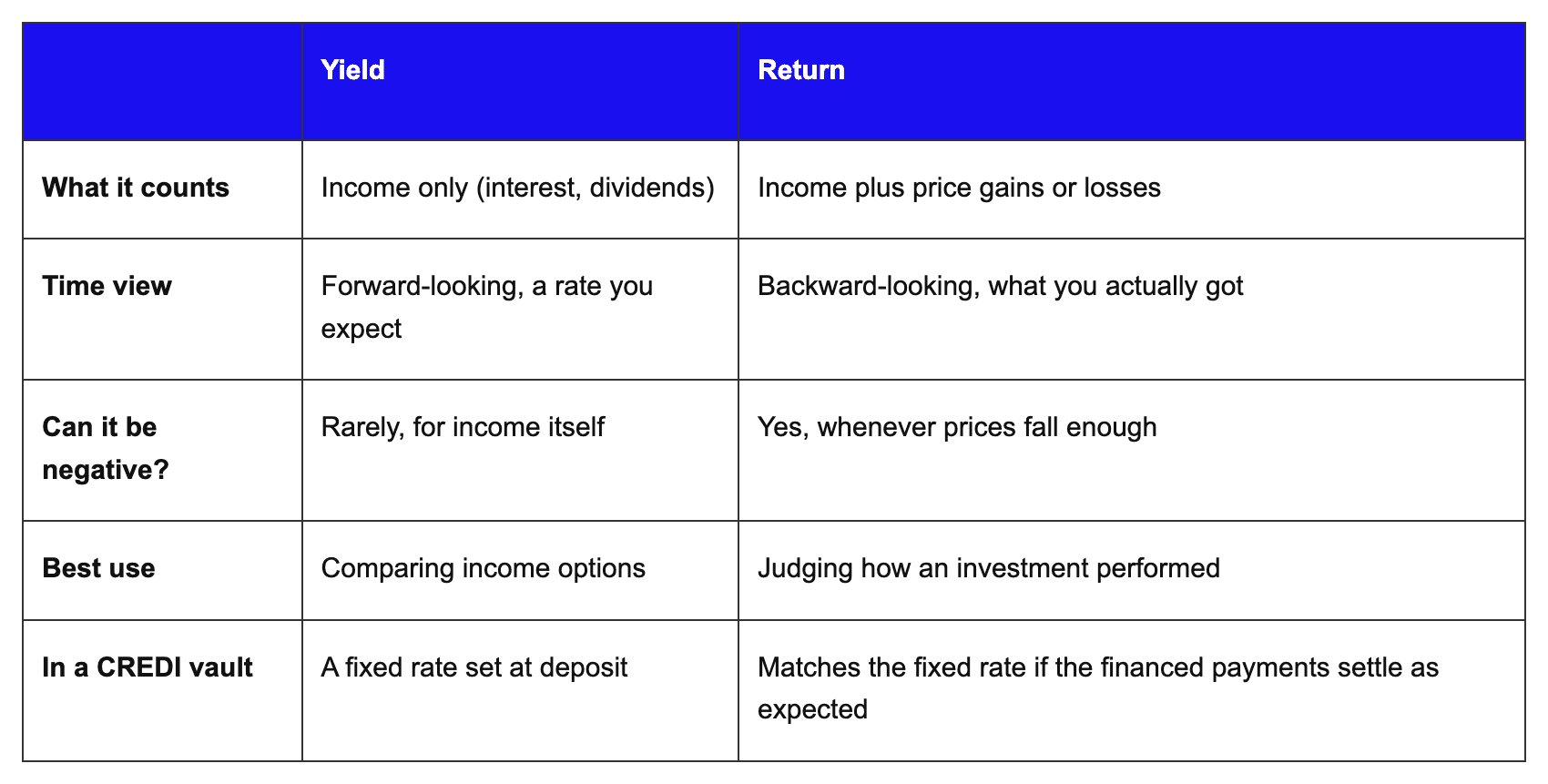
For an income investment with no market price swings, such as a CD held to maturity, yield and return line up closely. The same holds for a fixed rate set at deposit. In both cases the remaining question is whether the payer pays, which brings the analysis back to who is on the other side of your money.
Real yield is what is left after inflation
Real yield is your yield minus inflation, and it shows how much more your money can actually buy. If a bond pays 5% and prices rise 3% a year, your real yield is about 2%. A yield below inflation means your purchasing power shrinks, even while your balance grows.
The U.S. Treasury publishes real yields directly, through Treasury Inflation-Protected Securities (TIPS), bonds whose principal adjusts with inflation. On November 12, 2026, Treasury reported:
- 10-year Treasury note (nominal yield): 5.10%
- 10-year TIPS (real yield): 2.86% (U.S. Treasury, Daily Par Real Yield Curve Rates, November 2026)
- Gap: about 2.2 percentage points, roughly the yearly inflation the market expects over 10 years, often called breakeven inflation.
The same math applies to stablecoins. Deposits into a CREDI vault are in USDC, a dollar stablecoin, so the yield you earn is a dollar yield, and U.S. inflation reduces what it buys like it does for any dollar savings. Compare any yield you are offered against inflation, not against zero.
A high yield is a price for risk
When an investment offers a higher yield, the payer is telling you it values your money more or that your money is less safe, and often both. Investor.gov notes that high-yield bonds carry lower credit ratings and higher credit risk, so they "offer higher interest rates in return for the increased risk" (Investor.gov, Bonds). The same logic holds outside bonds.
Crypto adds a twist. A stablecoin on its own earns nothing for the person holding it: one dollar in, one dollar out.
So any stablecoin yield has to come from somewhere else: lending, trading activity, token rewards or financing real assets. Each source has a different payer and a different way to fail, and a headline rate tells you nothing about which one you are looking at. Our piece on the illusion of yield looks at how to tell them apart. A few questions sort most yields quickly:
- Who pays the yield, and from what cash flow?
- Is the rate fixed at deposit, or can it change?
- How long is your money committed?
- What has to go wrong for you to lose money?
For a CREDI vault, the answers are: card and trade receivables pay it, the rate is fixed at deposit, the lock period is set by the vault's terms, and a loss would come from payments failing to settle, a partner failing, or a smart contract or stablecoin problem.
Where CREDI fits: yield from financing the wait for settlement
CREDI connects onchain capital to real-world receivables, and its yield comes from financing the wait between a card swipe and its settlement, at a fixed rate set when you deposit. When a customer pays by card, the money takes days to move through the card network. Payment service providers (PSPs) give businesses access to those funds sooner, and CREDI vault capital finances that wait. When the payment settles, the vault is repaid.
Liquidity providers deposit stablecoins such as USDC into vaults built on Enzyme vault infrastructure on Ethereum, and the book is attested by Accountable, an external attester. Distribution runs through partners such as Turtle. As of October 2026, CREDI has funded $16.37M to date, with 0 realized losses to date. Our guide on why merchants wait to get paid explains the settlement cycle, and what on-chain private credit is covers the wider category.
In yield terms, the profile is short and specific:
- Who pays: the financing of card and trade receivables, repaid when card and trade payments settle.
- Rate: fixed when you deposit, for the vault's stated lock period.
- Duration of the assets: days to weeks.
- Main risks: credit risk if payments fail to settle, counterparty risk at payment partners, smart contract and stablecoin risk, and liquidity limited by the lock terms.
It is not risk free: the outcome depends on the financed payments settling as expected, and past results do not predict future ones.
Frequently Asked Questions
What does a 5% yield mean?
A 5% yield means the investment pays income equal to 5% of its price over a year. On $1,000, that is about $50 a year. For a savings account it usually refers to APY, which includes compounding. For a stock or bond it is calculated on the current price, so the figure changes as the price moves.
Is yield the same as interest?
Interest is one source of yield. Yield is the broader measure: it can come from interest on bonds and deposits, dividends on stocks, rent on property, or fees on financed receivables. Expressing all of them as a yearly percentage of what you invest is what makes them comparable.
Why do yields change?
Yields change when the income changes or when the price changes. Central bank rate moves shift savings and Treasury yields. Bond yields rise when prices fall. Dividend yields move with share prices and payout decisions. A rate fixed at the start of an investment, such as a CD or a fixed-rate vault deposit, stays the same for that term.
Can a yield be negative?
The income itself is rarely negative. What often turns negative is the real yield: it drops below zero when inflation runs above the yield you earn, so your money buys less each year even though the balance grows. A savings account paying well under the inflation rate is the most common everyday example.
What is yield on cost?
Yield on cost divides today's income by the price you originally paid instead of today's price. If you bought a share at $40 and it now pays $3 a year in dividends, your yield on cost is 7.5% (illustrative), even if a new buyer at today's price earns less.
Yield starts with knowing who pays it
Every yield, from a savings account to a stablecoin vault, comes down to the same short list: who pays, from what cash flow, at what rate, for how long, and what could stop the payments. If you want to see a yield that comes from financing card settlement at a rate fixed when you deposit, explore CREDI's vaults →
This article is for information only and is not financial, investment or legal advice.


